
You are here: Home1 / Resource2 / Technical Guidance3 / How to Select Hydraulic Hoses: 2 Wire vs 4 Wire Hydraulic Hose
How to Select Hydraulic Hoses: 2 Wire vs 4 Wire Hydraulic Hose
With 17 years of experience as a specialized hydraulic hose manufacturer, Utigoflex has helped over 1000+ global customers find suitable hydraulic hoses for construction, mining, agricultural, and industrial applications.
Many engineers and equipment purchasers often ask: Should I choose 2 Wire Hydraulic Hose or 4 Wire Hydraulic Hose? We fully understand the dilemma customers face when selecting hydraulic hoses. Choosing the wrong model not only wastes costs but can also lead to downtime at the worksite or even safety incidents.
Therefore, Utigoflex has compiled this comparison guide by combining our past service cases, expertise, and industry standards.
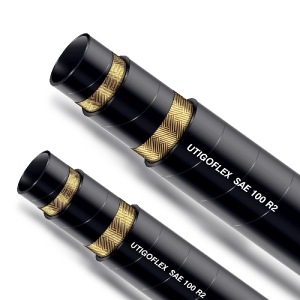
What is a 2 Wire Hydraulic Hose?
A 2 wire hydraulic hose (commonly SAE 100R2AT) contains two layers of high-tensile steel wire reinforcement. This structure provides good flexibility and moderate pressure resistance.
- Performance Characteristics: Offers excellent flexibility and moderate pressure resistance.
- Actual Data Reference: For the 1/2-inch (DN12) specification, Utigoflex SAE100 R2-8 has a working pressure of 4000 PSI (27.5 MPa) and a burst pressure of 15956 PSI (110.0 MPa), min bending radius is 100 mm.
- Applications: Suitable for medium-pressure hydraulic systems, such as agricultural machinery, forklifts, and light construction equipment.
- Advantages: Performs exceptionally well in confined installation spaces and offers superior cost-effectiveness for routine applications.
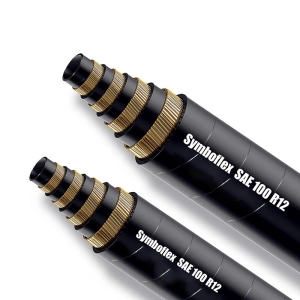
What is a 4 Wire Hydraulic Hose?
A 4 wire hydraulic hose (such as SAE 100R12 or SAE 100R13) contains four layers of spiral steel wire reinforcement. This design significantly increases pressure resistance and durability.
- Performance Characteristics: Offers excellent flexibility and moderate pressure resistance.
- Actual Data Reference: For the same 1/2-inch specification SAE 100 R12, the working pressure is 4060 PSI (28.0 MPa), burst pressure is 16240 PSI (112 MPa), and min bending radius is 180 mm.
- Applications: Specifically engineered for high-pressure and heavy-duty operations, such as excavators, mining machinery, and large-scale heavy-load construction equipment.
- Advantages: Delivers extended service life under demanding working conditions.
Core Parameter Comparison Table
| Structure | 2 Wire | 4 Wire |
| Typical Product | SAE 100 R2 AT | SAE 100 R12 |
| Pressure Rating | Medium Pressure | High Pressure |
| Flexibility | Excellent, small bending radius | Stiffer, with a larger bending radius |
| Pulse Resistance | General | Exceptionally robust, withstanding frequent impacts |
| Typical Applications | Agricultural machinery, forklift trucks, light industry | Excavators, mining machinery, heavy construction equipment |
Key Factors When Selecting a Hydraulic Hose
When choosing between 2 wire vs 4 wire hydraulic hose, Utigoflex suggests giving priority to the following four points when making decisions:
- Working Pressure: This is the primary criterion. If the system pressure exceeds the rated value of the 2nd layer pipe, it must be upgraded to the 4th layer pipe to ensure safety
- Space and Bending Requirements: In tight installation spaces, 2-layer hydraulic hoses with smaller minimum bending radii are recommended. They can withstand tighter, sharper turns without damage.
- Application Environment: In high-stress environments such as mines or construction sites, hoses must operate continuously under high pressure. Therefore, 4-layer hydraulic hoses are better equipped to withstand pressure pulses.
- Cost Efficiency: Where 2-layer hydraulic hoses can be used, there is no need to mandate the use of 4-layer hydraulic hoses, thereby avoiding unnecessary cost increases.

