
• Facebook
  • Youtube
  • Instagram
  • WhatsApp
Give us a call now: 13510833230
Utigoflex
  • Home
  • About Us
    • Certification
  • Product
    • Hydraulic Hose
      • Braided Steel Wire Hydraulic Hose
        • SAE 100 R1 / DIN EN 853 1SN
        • SAE 100 R2 AT / DIN EN 853 2SN
        • SAE 100 R5 Steel Wire Braided Hydraulic Hose
        • SAE 100 R16 Steel Wire Braided Hydraulic Hose
        • SAE 100 R17 Steel Wire Braided Hydraulic Hose
        • EN 857 1SC Steel Wire Braided Hydraulic Hose
        • EN 857 2SC Steel Wire Braided Hydraulic Hose
      • Spiraled Steel Wire Hydraulic Hose
        • SAE 100 R9 Steel Wire Spiraled Hydraulic Hose
        • SAE 100 R12 Steel Wire Spiraled Hydraulic Hose
        • SAE 100 R13 Steel Wire Spiraled Hydraulic Hose
        • SAE 100 R15 Steel Wire Spiraled Hydraulic Hose
        • EN 856 4SH Steel Wire Spiraled Hydraulic Hose
        • EN 856 4SP Steel Wire Spiraled Hydraulic Hose
      • Thermoplastic Hydraulic Hose
        • SAE 100 R7 Thermoplastic Hydraulic Hose
        • SAE 100 R8 Thermoplastic Hydraulic Hose
        • SAE 100 R14 Stainless Steel Wire Braided with PT
      • Braided Textile Hydraulic Hose
        • SAE 100 R3
        • SAE 100 R4 Textile Braided Hydraulic Hose
        • SAE 100 R6
        • EN 854 1TE/2TE/3TE Textile Braided Hydraulic Hose
    • Rubber Hose
      • EPDM Air & Water Hose
      • Chemical Suction & Discharge Hose
      • Steam Hose
      • Fuel & Diesel Delivery Hose
      • Fuel & Diesel Suction Hose
      • LPG/CNG Rubber Hose
      • Drilling Hose
      • Air Compressor Hose
      • High pressure Washing Hose
      • Marine High Pressure Oil Conveying Hose
      • Sand Blast Rubber Hose
      • Suction & Discharge Hose
      • Concrete Delivery Hose
      • Composite Hose
      • Food Grade Hose
      • EPDM Hot Water Hose
      • Stainless Steel Flexible Hose
    • PVC Hose
      • PVC Garden Hose
      • PVC Layflat Hose
      • Multi–Purpose PVC Air Hose – Matt Surface
      • Multi–Purpose PVC Air Hose – Shining Surface
      • Smooth Surface PVC Steel Wire Hose
      • PVC Fiber Hose
      • PVC High Pressure Spray Hose
      • PVC Corrugated Suction Hose
      • PVC Grit Hose
      • PVC Kink–Proof Suction Hose
      • PVC Interlocked Hose
      • Fuel Drop Hose
    • Industrial Hose
      • ANFO Explosive Loading Hose
      • Air Hose
      • Fuel & Oil Delivery Hose
      • Chemical Hose
      • Layflat Fire Hose
      • Welding Hose
      • High Pressure Spray Hose
      • PU Suction Hose
      • PU Anti Static Suction Hose
      • PU Step Hose
      • Polypropylene Drain Hose
    • Air Duct Hose
      • PU Air Duct
      • PU Air Duct With Black Strip
      • PVC Air Duct
      • TPR (TPE) Air Duct
      • TPR (TPE) Air Duct With Green Strip
      • Silicone Coated Glass Fiber Duct
      • Portable Ventilation Duct
      • Clamped High Temperature Duct
      • Clamped Polyester Duct
      • Clamped Tarpaulin Duct
      • EPDM Fume Exhaust Hose
    • Food Grade Hose
      • Food Grade Rubber Hose
      • Smooth Surface PVC Spiral Hose
      • Smooth Surface PVC Steel Wire Hose
      • PVC Fiber Hose
    • Pneumatic Hose
      • Nylon tubing
      • PU Pneumatic Hose
    • Hydraulic Fittings
    • Hose Camlocks
    • Hose Clamps
    • Crimping/Cutting Machine
      • Crimping Machine
      • Cutting Machine
    • Rubber Sheet
  • Services
    • Agriculture Hose Solution
    • Construction Hose Solution
    • Oil & Fuel Hose Solution
    • Chemical Industry Hose Solutions
    • Mining Hose Solution
    • Food Grade Hose Solution
  • Resources
    • Download Center
    • Technical Guides
    • Blog
      • Product Knowledge
      • Company News
  • Contact Us
  • Search
  • Menu Menu
You are here: Home1 / Resource2 / Technical Guidance3 / How Should Hydraulic Hoses Be Stored Properly?

How Should Hydraulic Hoses Be Stored Properly?

You just received a $5,000 shipment of hydraulic hoses. You toss them on a concrete floor in the back of the warehouse, next to a leaky window and an ozone-spewing electric motor. Six months later, you install one, and it fails within a week.

Was it a manufacturing defect? Probably not. It was storage rot.

Hydraulic hoses are not like steel beams. They are complex composites of rubber, steel wire, and synthetic compounds that degrade over time—even when sitting on a shelf. Improper storage can turn a brand-new hose into a ticking time bomb before it ever sees a drop of oil.

Here is the definitive guide to storing hydraulic hoses correctly.
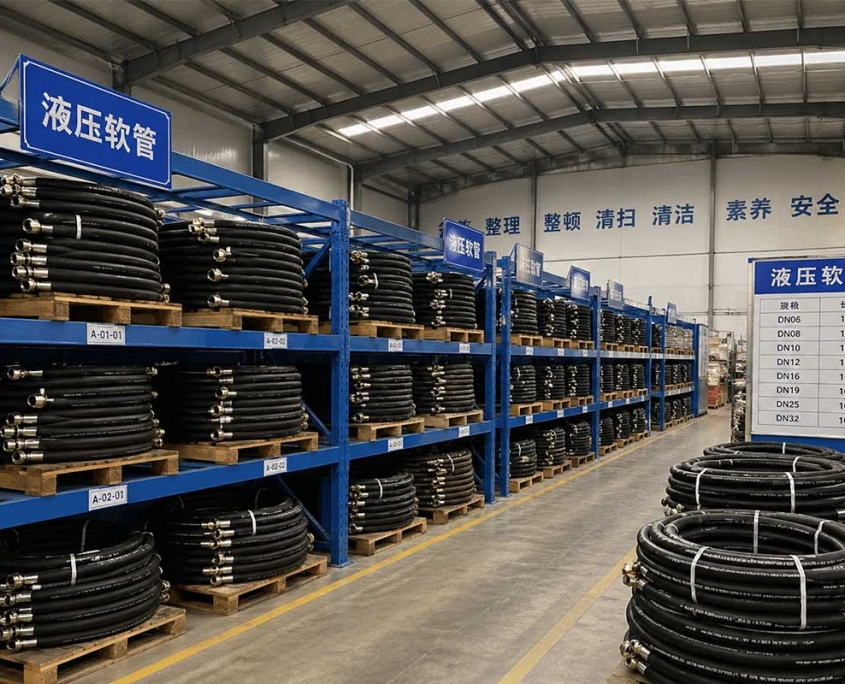
How Should Hydraulic Hoses Be Stored Properly

The Golden Rule: “First In, First Out” (FIFO)

Elastomers have a shelf life. Even in perfect conditions, a rubber hose will eventually harden, crack, or lose its flexibility. Always rotate your inventory. Use the oldest hoses first. Mark every box with the date of receipt.

Storage of Hydraulic Hoses: 6 Key Factors

1. Temperature: Avoid the Extremes

Ideal Range: 50°F to 80°F (10°C to 27°C).

The Danger: Above 100°F (38°C), the rubber accelerates its vulcanization process (it cures further, becoming hard and brittle). Below -10°F (-23°C), the hose becomes rigid and will crack if moved.

Pro Tip: Never store hoses near steam pipes, boilers, or roof surfaces in summer. A shipping container in July can hit 140°F—that will destroy hoses in weeks.

2. Humidity: The Silent Enemy

Ideal: Below 65% relative humidity.

The Problem: High humidity causes the steel wire reinforcement to corrode from the inside out. You won’t see the rust until the hose bursts.

What to do: Store hoses off the floor (moisture rises from concrete). Use a dehumidifier in coastal or rainy climates.

3. Light: UV is a Killer

The Rule: Total darkness or low UV light.

Why: Ultraviolet radiation breaks down the molecular chains of rubber (photo-degradation). The hose will develop a chalky, cracked surface.

Action Item: Keep hoses in their original opaque packaging. If you must store them loose, cover them with a tarp or keep them in a windowless room. Fluorescent lights emit UV too—maintain distance.

4. Ozone & Electrical Equipment

This is the most overlooked killer.

The Source: Electric motors, welding machines, transformers, and even some fluorescent light ballasts generate ozone (O₃).

The Effect: Ozone attacks the double bonds in rubber polymers, causing “alligator cracking” (tiny perpendicular cracks) on the surface.

The Fix: Store hoses in a separate room away from any electrical machinery. Never hang hoses directly above a running hydraulic power unit.

5. Mechanical Stress: Don’t Crush or Stretch

Hanging: If hanging long hoses, support them at multiple points (every 3–4 feet). Never hang a heavy, large-diameter hose from a single nail—the weight will stretch the top section.

Coiling: Use the natural lay of the hose. Do not twist it. Large hoses should be stored in a “figure-8” coil to prevent kinking.

Flat Surfaces: Never stack heavy objects on top of hoses. Do not store hoses under pallets of parts.

6. Contact with Contaminants

Hoses act like sponges for certain chemicals.

Keep away from: Fuels, solvents, acids, oils (other than the fluid they are rated for), and grease.

Also avoid: Copper, manganese, or iron dust. These metals accelerate oxidation of the rubber.

Do not use: Markers or paint on the hose jacket. The solvents in permanent markers can penetrate the rubber. Use tags or labels instead.

What Should Be Done If a Hydraulic Hose Has Exceeded Its Shelf Life?

Even with perfect storage, hydraulic hoses do not last forever.

Thermoplastic hoses: Up to 10 years (if stored perfectly).

Wire-braided rubber hoses: 5–6 years maximum.

Wire-spiral rubber hoses (high pressure): 5 years maximum.

The Rule of Thumb: If a hose has been in storage for more than 5 years, do not use it for critical applications (excavators, presses, aerial lifts). Demote it to low-pressure return lines or scrap it.

Preparations to Make Before Storing Hydraulic Hoses

Post this in your warehouse:

Environment: Cool, dry, dark, and clean. (50–80°F, <65% humidity)

Isolation: Away from electric motors, ozone, and welding fumes.

Position: Horizontal on racks or shelves. Off the concrete floor.

Shape: Large, loose coils. No tight bends or kinks

Labeling: Date of receipt clearly visible. FIFO enforced.

What About Hoses Already in Service?

If you are removing a hose for “temporary” storage (e.g., seasonal equipment), you must cap the ends immediately. Moisture inside the hose will corrode the steel wire from within. Use plastic caps or tape to seal the ends. Store it as if it were new.

The Bottom Line

Hydraulic hose failures account for approximately 25% of unplanned downtime in industrial settings. The vast majority of these failures are not due to design defects, but rather to improper storage prior to installation.
Treat your hose inventory like fresh produce—it has a limited shelf life and requires the right conditions. A $50 storage rack and a $30 thermo-hygrometer are an inexpensive way to prevent $10,000 in equipment failures.

Remember: If it was stored wrong, it will fail fast. When in doubt, throw it out.

  • Facebook
  • X
  • LinkedIn
  • Youtube
  • Instagram
  • steven@utigoflexhose.com
  • FACEBOOK
  • Instagram
  • YOUTUBE
  • 13510833230

Company

    • About Us
    • Products
    • Resources
    • Contact Us

Product

  • Hydraulic Hose
  • Rubber Hose
  • PVC Hose
  • Industrial Hose
  • Air Duct Hose
  • Food Grade Hose
  • Pneumatic Hose

Technical Support

    • Plastic Hoses Catalogue
    • Rubber Hose Catalogue
    • Hydraulic Fittings Catalogue
    • Privacy Policy

Follow Us

Copyright @ Utigoflex | All rights reserved
How to Choose the Right Hose Clamp for Your IndustryHow to Choose the Right Hose Clamp for Your IndustryWhich Hose Material is Best for High Temperature and High PressureWhich Hose Material is Best for High Temperature and High Pressure?
Scroll to top

This site uses cookies. By continuing to browse the site, you are agreeing to our use of cookies.

Agree & ContinueSettingsReject

Cookie and Privacy Settings


How we use cookies

We may request cookies to be set on your device. We use cookies to let us know when you visit our websites, how you interact with us, to enrich your user experience, and to customize your relationship with our website.

Click on the different category headings to find out more. You can also change some of your preferences. Note that blocking some types of cookies may impact your experience on our websites and the services we are able to offer.

Essential Website Cookies

These cookies are strictly necessary to provide you with services available through our website and to use some of its features.

Because these cookies are strictly necessary to deliver the website, refusing them will have impact how our site functions. You always can block or delete cookies by changing your browser settings and force blocking all cookies on this website. But this will always prompt you to accept/refuse cookies when revisiting our site.

We fully respect if you want to refuse cookies but to avoid asking you again and again kindly allow us to store a cookie for that. You are free to opt out any time or opt in for other cookies to get a better experience. If you refuse cookies we will remove all set cookies in our domain.

We provide you with a list of stored cookies on your computer in our domain so you can check what we stored. Due to security reasons we are not able to show or modify cookies from other domains. You can check these in your browser security settings.

Google Analytics Cookies

These cookies collect information that is used either in aggregate form to help us understand how our website is being used or how effective our marketing campaigns are, or to help us customize our website and application for you in order to enhance your experience.

If you do not want that we track your visit to our site you can disable tracking in your browser here:

Other external services

We also use different external services like Google Webfonts, Google Maps, and external Video providers. Since these providers may collect personal data like your IP address we allow you to block them here. Please be aware that this might heavily reduce the functionality and appearance of our site. Changes will take effect once you reload the page.

Google Webfont Settings:

Google Map Settings:

Google reCaptcha Settings:

Vimeo and Youtube video embeds:

Other cookies

The following cookies are also needed - You can choose if you want to allow them:

Privacy Policy

You can read about our cookies and privacy settings in detail on our Privacy Policy Page.

Privacy Policy
Accept settingsHide notification only
Skip to content
Open toolbar Accessibility Tools

Accessibility Tools

  • Increase TextIncrease Text
  • Decrease TextDecrease Text
  • GrayscaleGrayscale
  • High ContrastHigh Contrast
  • Negative ContrastNegative Contrast
  • Light BackgroundLight Background
  • Links UnderlineLinks Underline
  • Readable FontReadable Font
  • Reset Reset