
You are here: Home1 / Blog2 / Product Knowledge3 / Which Hose Material is Best for High Temperature and High Pressure?
A Technical Guide to Avoiding Catastrophic Failure
A Technical Guide to Avoiding Catastrophic Failure
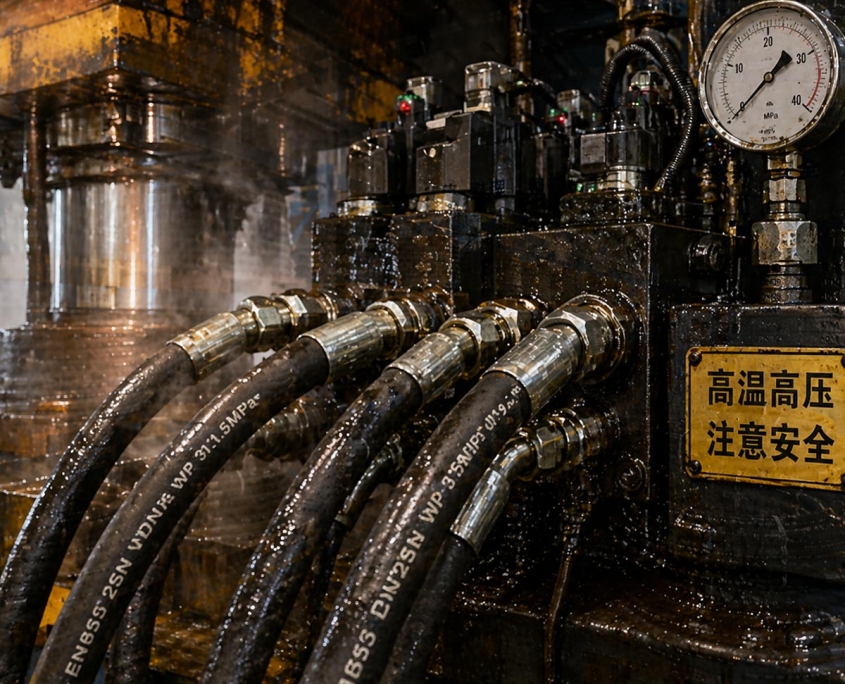
When your application demands a hose that can handle both extreme heat and intense pressure, you step out of the realm of standard rubber hoses. You are now looking for a material that can resist thermal degradation, oxidation, and blistering—all while holding back hundreds or thousands of PSI.
Choosing the wrong material isn’t just inefficient; it is dangerous. A burst hose in a high-pressure steam line or a hydraulic press can cause severe injuries and costly downtime.
The following is a detailed analysis of the three best materials for applications in high-temperature and high-pressure environments, along with a comparison of which performs better in specific scenarios.
The Top Contenders
1. PTFE (Polytetrafluoroethylene) – The All-Rounder Winner
Best for: Chemical transfer, hydraulic lines, steam (with special construction), and food processing.
If you need a single material that does it all, PTFE is the industry standard for high-temperature, high-pressure resistance.
Temperature Range: -65°F to 450°F (-54°C to 232°C).
Pressure Capacity: Excellent (can exceed 6,000 PSI depending on stainless steel braiding).
Why it works: PTFE has a very low coefficient of friction (nothing sticks to it) and is chemically inert. When braided with stainless steel wire, the hose gains immense burst strength while the PTFE liner handles the heat.
The Catch: PTFE is stiff. It has a very tight bend radius, making it difficult to route in tight spaces. It also does not “relax” once bent.
2. Stainless Steel Corrugated Hose – The Heavyweight
Best for: Saturated steam, exhaust lines, and high-vibration environments.
When temperatures exceed 400°F (204°C), most polymer liners (including standard PTFE) begin to degrade over time. For superheated steam or direct exhaust, all-metal hose is the only answer.
Temperature Range: Up to 1,650°F (899°C) with proper alloy.
Pressure Capacity: Moderate to High (limited by corrugation).
Why it works: There is no rubber or plastic to melt. Stainless steel (316L or 321) offers excellent oxidation resistance.
The Catch: Metal hoses are susceptible to work hardening. If you vibrate or flex them constantly, they will crack from fatigue. They are also heavy and expensive.
3. Synthetic Rubber with Steel Wire (e.g., UHMWPE,Viton)
Best for: Dynamic applications (constant flexing) and oil-based fluids.
Standard rubber (Nitrile) fails above 212°F. However, advanced thermosets like UHMWPE can bridge the gap.
Temperature Range: Viton can handle up to 400°F (204°C) intermittently.
Pressure Capacity: Very High (Hydraulic hoses routinely run at 5,000–10,000 PSI).
Why it works: These hoses are incredibly flexible. Unlike PTFE, they bend easily, making them ideal for robotics and mobile equipment.
The Catch: Burn risk. Even though Viton handles 400°F, if the fluid inside spikes to 500°F due to a malfunction, the hose will turn into charcoal. It is also susceptible to “explosive decompression” if high-pressure gas is suddenly released.
The Verdict: Which should you choose?
Stop asking “Which is best?” and start asking “What are my operating parameters?”
For chemical resistance and high PSI applications: select SS braided PTFE hose.For high-temperature steam and exhaust systems: select stainless steel corrugated hose
What Should be Avoided?
Do not use General Purpose Rubber (EPDM or Nitrile) for high-heat, high-pressure combinations. Once you cross 250°F (121°C) , standard rubber softens, the reinforcement wire digs into the tube, and blowouts are imminent.
Also, avoid Nylon or Polyurethane hoses. They are great for cold high pressure, but they melt below 300°F.
Safety Tip: Always derate your hose as temperature increases. A hose rated for 5,000 PSI at 70°F may only be rated for 2,500 PSI at 400°F. Always consult the manufacturer’s pressure-temperature chart before installation.

