
You are here: Home1 / Blog2 / Product Knowledge3 / How to Choose the Right Hose Clamp for Your Industry
How to Choose the Right Hose Clamp for Your Industry
We often take them for granted. They are small, cheap, and seemingly simple. But when a $0.50 hose clamp fails, it can cause $50,000 in downtime, wreck a hydraulic system, or create a dangerous leak in a chemical plant.
Choosing the right hose clamp isn’t just about stopping a drip; it’s about safety, longevity, and regulatory compliance.
Whether you work in Automotive, Food & Beverage, Marine, or Heavy Industrial manufacturing, here is your guide to selecting the perfect clamp for the job.
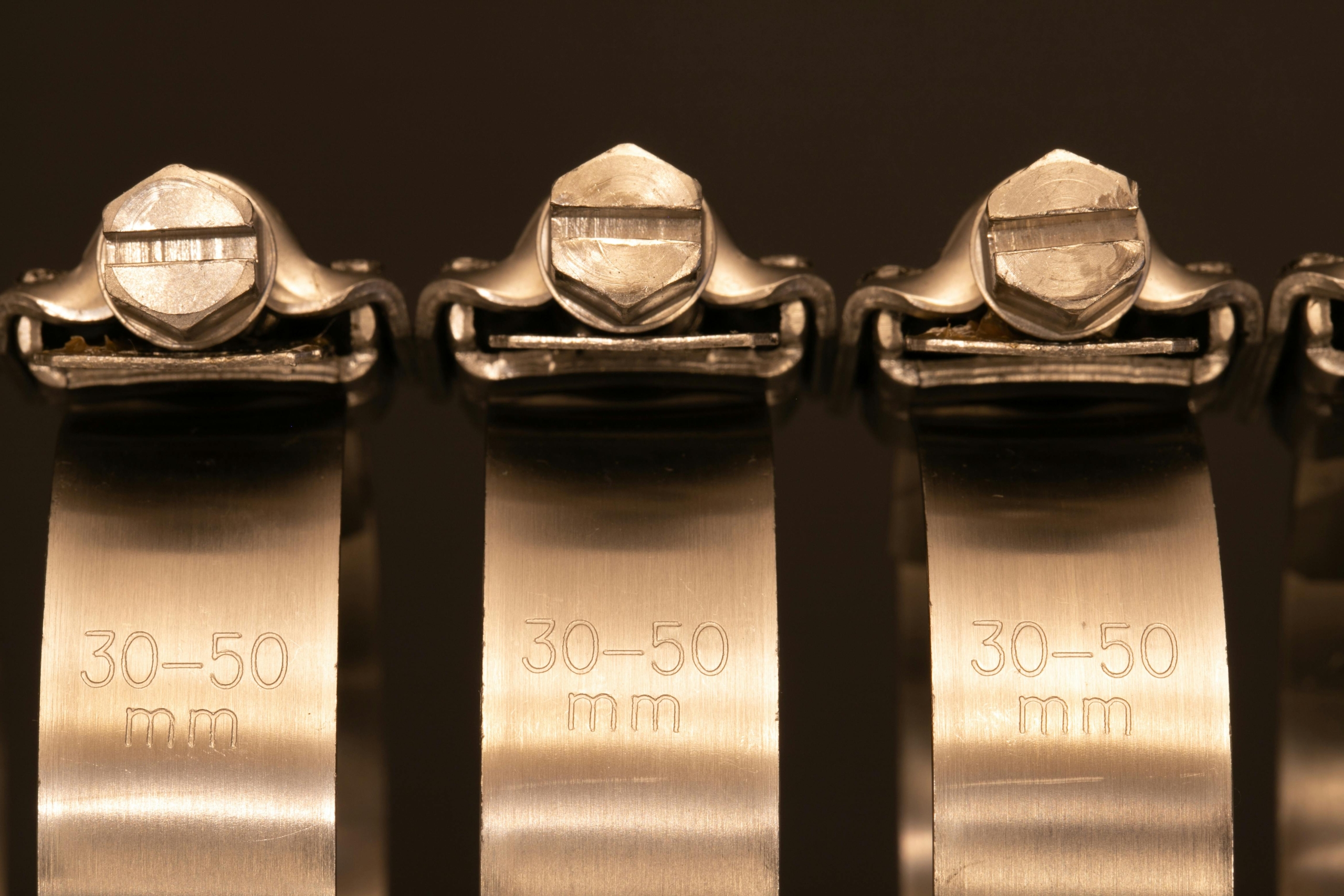
1. The “Material Match” Rule
Before looking at the style of the clamp, you must look at the environment.
Standard Steel (Zinc Plated): Fine for dry indoor applications (data centers, HVAC). Avoid in high humidity.
Stainless Steel (304 vs. 316):
Grade 304: The workhorse. Resists water and most chemicals. Good for automotive and general industrial use.
Grade 316: The “Marine Grade.” Contains molybdenum. Essential for pharmaceutical, food processing, and saltwater environments.
Electro-polished: A must for the Biotech/Pharma industry to prevent bacteria from clinging to micro-ridges on the metal.
2. Industry-Specific Breakdown
Automotive & Heavy Trucking (Fuel, Coolant, Air Intake)
The Enemy: Vibration, temperature swings (-40°F to 300°F), and oil contamination.
The Wrong Choice: Standard worm-drive clamps with perforations. The slots cut into the band bite into rubber hoses, causing failure under vibration.
The Right Choice:
Lined Clamps: A stainless steel band with a perforation-free inner liner (usually EPDM or silicone) that protects the hose.
Constant Tension Clamps: These use a spring mechanism to keep tension as hoses expand and contract with heat.
Food & Beverage / Dairy
The Enemy: Bacteria entrapment and caustic washdowns (CIP cleaning).
The Wrong Choice: Standard worm-drive. The gaps in the screw housing are perfect breeding grounds for listeria.
The Right Choice:
Sanitary Clamps (Tri-Clamp): These use a separate gasket and a hinged clamp that applies even 360-degree pressure. They are quick-release and allow for zero dead-legs.
Heavy Duty Smooth Band: For low-pressure applications, the band must be solid (no slots) and the housing must be sealed.
Marine & Offshore (Oil Rigs, Boating)
The Enemy: Saltwater corrosion (Chlorides) and galvanic corrosion.
The Right Choice: Alloy 316 (Marine Grade) or Titanium. Never mix metals. A 316 clamp on a bronze fitting is fine, but never put a zinc-plated clamp on a stainless fitting—it will corrode instantly.
Pneumatics & Industrial Vacuum
The Enemy: Suction collapse (crushing) and blow-off (pressure).
The Right Choice: Oetiker or Ear Clamps. These are permanent clamps crimped with a pincer tool. They provide a perfect, even seal that doesn’t crush thin plastic or nylon tubing. They are the gold standard for air brakes on semi-trucks
3. The Three “S” Decision Tree
If you don’t know where to start, answer these three questions:
Situation 1: Is the assembly taken apart often?
Yes: Go with Quick-Release (Toggle or Cam-locking styles). Screw clamps wear out after 5-6 cycles.
No: Go with Worm-drive or Crimp (Crimp is cheapest and most reliable for permanent assembly).
Situation 2: Is the pressure high or surging?
Yes: You need a Bolted Heavy Duty Clamp (2-bolt or 4-bolt). These are thick steel used for silicone hose connections on turbochargers. A worm-drive will explode under 50+ PSI surges.
Situation 3: Does the hose have a wire helix (Suction hose)?
Yes: You need a Wide Band Clamp (at least 1″ wide). A narrow clamp will buckle between the wire ridges and cause a leak.
4. The Most Common Mistake: Over-tightening
The biggest mistake across every industry is using the “German torque spec” (Gudentite). Cranking a clamp as tight as possible actually causes the hose to extrude out from under the clamp band (cold flow).
The Fix: Use a torque screwdriver or a pre-calibrated ratchet clamp. If you see the rubber bulging out of the slots in the clamp, you have already lost the seal.
The Takeaway: Never buy the $0.10 clamp for a $1,000 hose assembly. The clamp is the weakest point of any fluid system. By matching the material to your environment and the style to your vibration level, you can extend the life of your equipment by years.

