
• Facebook
  • Youtube
  • Instagram
  • WhatsApp
Give us a call now: 13510833230
Utigoflex
  • Home
  • About Us
    • Certification
  • Product
    • Hydraulic Hose
      • Braided Steel Wire Hydraulic Hose
        • SAE 100 R1 / DIN EN 853 1SN
        • SAE 100 R2 AT / DIN EN 853 2SN
        • SAE 100 R5 Steel Wire Braided Hydraulic Hose
        • SAE 100 R16 Steel Wire Braided Hydraulic Hose
        • SAE 100 R17 Steel Wire Braided Hydraulic Hose
        • EN 857 1SC Steel Wire Braided Hydraulic Hose
        • EN 857 2SC Steel Wire Braided Hydraulic Hose
      • Spiraled Steel Wire Hydraulic Hose
        • SAE 100 R9 Steel Wire Spiraled Hydraulic Hose
        • SAE 100 R12 Steel Wire Spiraled Hydraulic Hose
        • SAE 100 R13 Steel Wire Spiraled Hydraulic Hose
        • SAE 100 R15 Steel Wire Spiraled Hydraulic Hose
        • EN 856 4SH Steel Wire Spiraled Hydraulic Hose
        • EN 856 4SP Steel Wire Spiraled Hydraulic Hose
      • Thermoplastic Hydraulic Hose
        • SAE 100 R7 Thermoplastic Hydraulic Hose
        • SAE 100 R8 Thermoplastic Hydraulic Hose
        • SAE 100 R14 Stainless Steel Wire Braided with PT
      • Braided Textile Hydraulic Hose
        • SAE 100 R3
        • SAE 100 R4 Textile Braided Hydraulic Hose
        • SAE 100 R6
        • EN 854 1TE/2TE/3TE Textile Braided Hydraulic Hose
    • Rubber Hose
      • EPDM Air & Water Hose
      • Chemical Suction & Discharge Hose
      • Steam Hose
      • Fuel & Diesel Delivery Hose
      • Fuel & Diesel Suction Hose
      • LPG/CNG Rubber Hose
      • Drilling Hose
      • Air Compressor Hose
      • High pressure Washing Hose
      • Marine High Pressure Oil Conveying Hose
      • Sand Blast Rubber Hose
      • Suction & Discharge Hose
      • Concrete Delivery Hose
      • Composite Hose
      • Food Grade Hose
      • EPDM Hot Water Hose
      • Stainless Steel Flexible Hose
    • PVC Hose
      • PVC Garden Hose
      • PVC Layflat Hose
      • Multi–Purpose PVC Air Hose – Matt Surface
      • Multi–Purpose PVC Air Hose – Shining Surface
      • Smooth Surface PVC Steel Wire Hose
      • PVC Fiber Hose
      • PVC High Pressure Spray Hose
      • PVC Corrugated Suction Hose
      • PVC Grit Hose
      • PVC Kink–Proof Suction Hose
      • PVC Interlocked Hose
      • Fuel Drop Hose
    • Industrial Hose
      • ANFO Explosive Loading Hose
      • Air Hose
      • Fuel & Oil Delivery Hose
      • Chemical Hose
      • Layflat Fire Hose
      • Welding Hose
      • High Pressure Spray Hose
      • PU Suction Hose
      • PU Anti Static Suction Hose
      • PU Step Hose
      • Polypropylene Drain Hose
    • Air Duct Hose
      • PU Air Duct
      • PU Air Duct With Black Strip
      • PVC Air Duct
      • TPR (TPE) Air Duct
      • TPR (TPE) Air Duct With Green Strip
      • Silicone Coated Glass Fiber Duct
      • Portable Ventilation Duct
      • Clamped High Temperature Duct
      • Clamped Polyester Duct
      • Clamped Tarpaulin Duct
      • EPDM Fume Exhaust Hose
    • Food Grade Hose
      • Food Grade Rubber Hose
      • Smooth Surface PVC Spiral Hose
      • Smooth Surface PVC Steel Wire Hose
      • PVC Fiber Hose
    • Pneumatic Hose
      • Nylon tubing
      • PU Pneumatic Hose
    • Hydraulic Fittings
    • Hose Camlocks
    • Hose Clamps
    • Crimping/Cutting Machine
      • Crimping Machine
      • Cutting Machine
  • Services
    • Agriculture Hose Solution
    • Construction Hose Solution
    • Oil & Fuel Hose Solution
    • Chemical Industry Hose Solutions
    • Mining Hose Solution
    • Food Grade Hose Solution
  • Resources
    • Download Center
    • Blog
      • Product Knowledge
      • Company News
  • Contact Us
  • Search
  • Menu Menu
You are here: Home1 / Blog2 / Product Knowledge3 / 100°C vs 400°C Flexible Duct: How to Choose

100°C vs 400°C Flexible Duct: How to Choose the Right High Temperature Duct?

When specifying a flexible duct for high-temperature applications, the temperature rating is often the first—and most critical—decision point. But choosing between a 100°C duct and a 400°C duct isn’t simply a matter of picking the higher number. The right choice depends on your actual operating conditions, the media being conveyed, and the mechanical demands of your installation.

This guide breaks down the key differences between clamped polyester fabric ducts and clamped high-temperature ducts, so you can specify with confidence.

Understanding the Two Temperature Classes

100°C Class: Clamped Polyester Fabric Duct

This duct is built with a PVC-coated polyester fabric wall and a zinc-plated steel clamp profile. Its working temperature range spans -20°C to +100°C. It’s designed for extracting high-temperature air and cold air, handling solids like dust, powder, and fibers, and conveying gaseous media such as vapors and smoke.
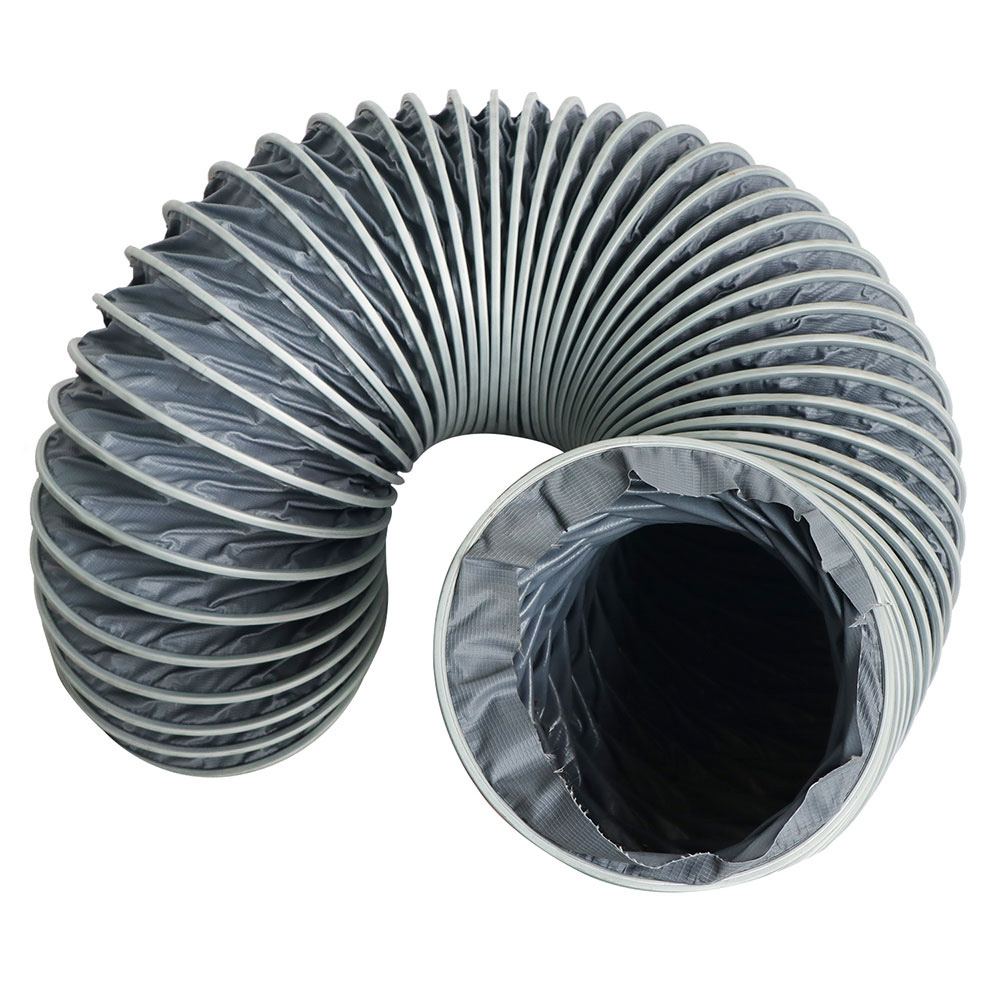
100°C Class: Clamped Polyester Fabric Duct

400°C Class: Clamped High Temperature Duct

This duct uses a silicone-coated glass fiber fabric wall, also with a zinc-plated steel clamp profile. Its working range extends from -60°C to +400°C. It’s engineered for more extreme conditions—engine exhaust suction, high-temperature vapors and smoke, and use in dryers, automotive, aerospace, shipbuilding, and military applications.
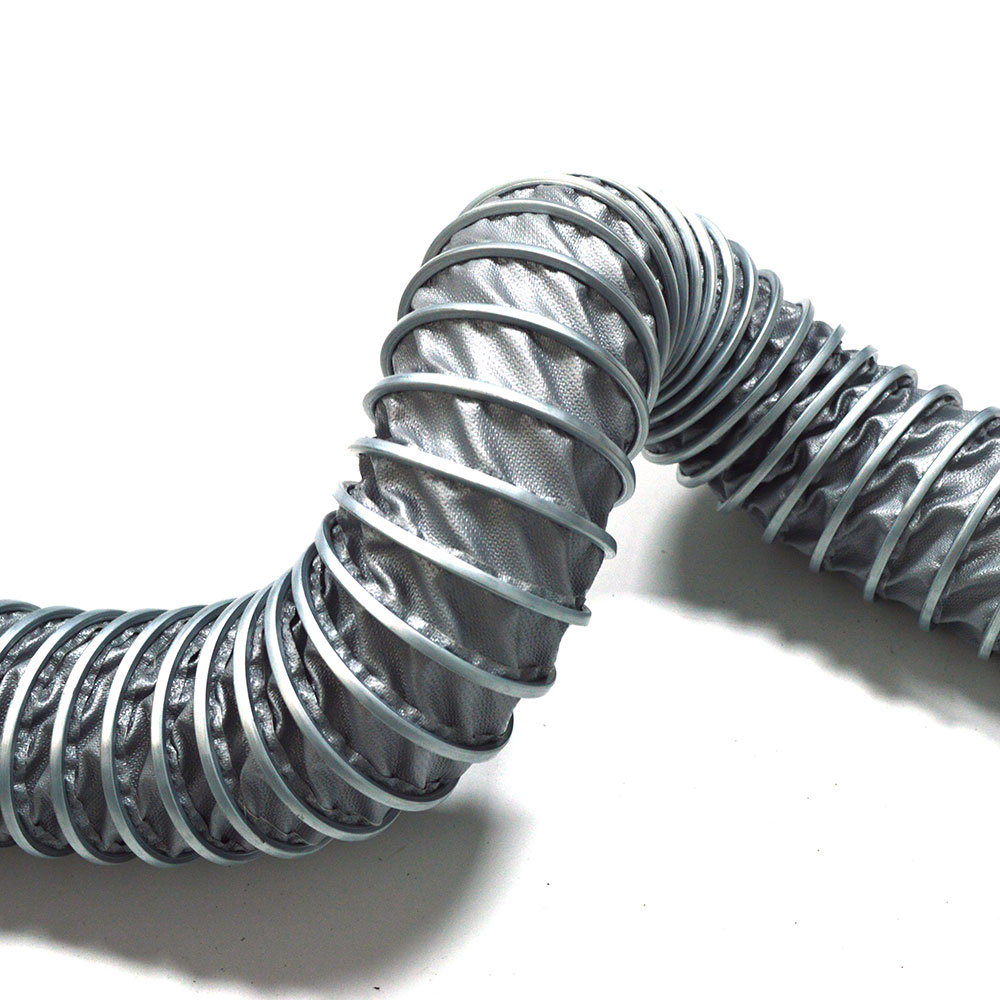
400°C Class: Clamped High Temperature Duct

Key Differences at a Glance

Feature 100°C Duct 400°C Duct
Wall Material PVC-coated polyester fabric Silicone-coated glass fiber fabric
Temp Range -20°C to +100°C -60°C to +400°C
Media Air, dust, powder, fibers, vapors, smoke High-temp air, vapors, smoke, exhaust
Abrasion Protection External steel spiral External galvanized steel helix
Flexibility Highly flexible and compressible Highly flexible and compressible
Bending Radius Small Small
Flame Retardant Yes Yes
Kink-Proof Yes Yes
Chemical Resistance Good Good

Both ducts share several core characteristics: a firm clamping structure, high flexibility, compressibility, small bending radius, kink resistance, and lightweight construction. The primary differentiators are temperature ceiling and wall material.

When to Choose the 100°C Duct

The PVC-coated polyester duct is the practical choice for most standard industrial ventilation and extraction tasks. It excels in:

  • Dust and powder extraction — its abrasion-resistant steel spiral handles particulate matter well
  • Fume and vapor removal — suitable for welding fumes, smoke, and general workshop ventilation
  • Cold air delivery — works across its full range down to -20°C
  • Dryer and automotive applications — where temperatures stay within the 100°C ceiling

If your process never exceeds 100°C and you’re primarily moving air, dust, or light solids, this duct offers an excellent balance of performance and cost-efficiency. Utigoflex manufactures this duct with a firm clamping structure that maintains integrity under repeated flexing, and the external steel spiral protects against abrasion in demanding particulate applications.

It’s worth noting that the 100°C duct performs best in continuous-duty environments where temperatures remain stable. If your process involves occasional temperature spikes approaching the ceiling, consider whether a higher-rated duct would provide better long-term reliability.

When to Choose the 400°C Duct

The silicone-coated glass fiber duct is engineered for genuinely demanding thermal environments. Choose it when:

  • Engine exhaust suction is required — the 400°C rating handles hot exhaust gases directly
  • High-temperature vapors and smoke are present — silicone-coated glass fiber resists degradation where PVC would fail
  • Aerospace, military, or shipbuilding specifications demand extreme temperature tolerance
  • Dryer systems operate at elevated temperatures beyond 100°C

The galvanized steel helix provides crush resistance, while the silicone coating delivers reliable performance across a -60°C to +400°C span. For applications where temperature spikes are possible, the 400°C duct provides essential safety margin.

This duct is also well-suited for use as bellows and compensators, where both flexibility and thermal resistance are required simultaneously. In these dynamic applications, the duct must absorb movement while withstanding heat—a combination that demands the silicone/glass fiber construction.

Practical Selection Checklist

Before specifying, ask:

  1. What is the maximum continuous operating temperature? Add a safety margin—typically 20-30%.
  2. Are there temperature spikes? If yes, rate for the peak, not the average.
  3. What media is being conveyed? Dust and powder favor abrasion-resistant designs; exhaust gases require high-temp materials.
  4. What is the ambient temperature? Both ducts have minimum ratings—ensure your environment falls within range.
  5. How much flexibility is needed? Both offer small bending radius, but confirm routing requirements.
  6. Are chemicals present? Both offer good chemical resistance, but verify compatibility with your specific media.

Cost vs. Performance

The 100°C duct offers a more economical solution for applications within its temperature range. The 400°C duct carries a higher cost due to its specialized silicone-coated glass fiber construction, but that investment is essential when the application demands it.

The decision should not be made on price alone. A 100°C duct used in a 200°C application will fail prematurely, creating downtime, safety risks, and replacement costs that far exceed the initial savings. Conversely, specifying a 400°C duct for a 60°C application is over-engineering that adds unnecessary expense.

Conclusion

Choosing between a 100°C and 400°C flexible duct comes down to understanding your actual operating conditions. For standard ventilation, dust extraction, and moderate-temperature air handling, the PVC-coated polyester duct delivers reliable, cost-effective performance. For engine exhaust, high-temperature vapors, and extreme industrial environments, the silicone-coated glass fiber duct is the necessary choice.

Build Your Safe Systems with Utigoflex

Utigoflex manufactures both options with firm clamping structures, external steel reinforcement, and flame-retardant construction. When in doubt, specify the higher temperature rating—the modest cost difference is far outweighed by the safety and durability margin it provides.

[Contact Utigoflex Today] to request a specialized quote or download our complete technical assembly catalog.

byadministratorSkila/October 8, 2026/inBlog, Product Knowledge
  • Facebook
  • X
  • LinkedIn
  • Youtube
  • Instagram
  • steven@utigoflexhose.com
  • FACEBOOK
  • Instagram
  • YOUTUBE
  • 13510833230

Company

    • About Us
    • Products
    • Resources
    • Contact Us

Product

  • Hydraulic Hose
  • Rubber Hose
  • PVC Hose
  • Industrial Hose
  • Air Duct Hose
  • Food Grade Hose
  • Pneumatic Hose

Technical Support

    • Plastic Hoses Catalogue
    • Rubber Hose Catalogue
    • Hydraulic Fittings Catalogue
    • Privacy Policy

Follow Us

Copyright @ Utigoflex | All rights reserved
EPDM vs Silicone Hose: Which Is Better for High Temperatures?What Is a Fuel Drop Hose? Uses & Selection Guide
Scroll to top

This site uses cookies. By continuing to browse the site, you are agreeing to our use of cookies.

Agree & ContinueSettingsReject

Cookie and Privacy Settings


How we use cookies

We may request cookies to be set on your device. We use cookies to let us know when you visit our websites, how you interact with us, to enrich your user experience, and to customize your relationship with our website.

Click on the different category headings to find out more. You can also change some of your preferences. Note that blocking some types of cookies may impact your experience on our websites and the services we are able to offer.

Essential Website Cookies

These cookies are strictly necessary to provide you with services available through our website and to use some of its features.

Because these cookies are strictly necessary to deliver the website, refusing them will have impact how our site functions. You always can block or delete cookies by changing your browser settings and force blocking all cookies on this website. But this will always prompt you to accept/refuse cookies when revisiting our site.

We fully respect if you want to refuse cookies but to avoid asking you again and again kindly allow us to store a cookie for that. You are free to opt out any time or opt in for other cookies to get a better experience. If you refuse cookies we will remove all set cookies in our domain.

We provide you with a list of stored cookies on your computer in our domain so you can check what we stored. Due to security reasons we are not able to show or modify cookies from other domains. You can check these in your browser security settings.

Google Analytics Cookies

These cookies collect information that is used either in aggregate form to help us understand how our website is being used or how effective our marketing campaigns are, or to help us customize our website and application for you in order to enhance your experience.

If you do not want that we track your visit to our site you can disable tracking in your browser here:

Other external services

We also use different external services like Google Webfonts, Google Maps, and external Video providers. Since these providers may collect personal data like your IP address we allow you to block them here. Please be aware that this might heavily reduce the functionality and appearance of our site. Changes will take effect once you reload the page.

Google Webfont Settings:

Google Map Settings:

Google reCaptcha Settings:

Vimeo and Youtube video embeds:

Other cookies

The following cookies are also needed - You can choose if you want to allow them:

Privacy Policy

You can read about our cookies and privacy settings in detail on our Privacy Policy Page.

Privacy Policy
Accept settingsHide notification only
Skip to content
Open toolbar Accessibility Tools

Accessibility Tools

  • Increase TextIncrease Text
  • Decrease TextDecrease Text
  • GrayscaleGrayscale
  • High ContrastHigh Contrast
  • Negative ContrastNegative Contrast
  • Light BackgroundLight Background
  • Links UnderlineLinks Underline
  • Readable FontReadable Font
  • Reset Reset