
You are here: Home1 / Blog2 / Product Knowledge3 / EPDM vs Silicone Hose: Which Is Better for High Temperatures?
EPDM vs Silicone Hose: Which Is Better for High-Temperature Applications?
When a hose operates at elevated temperatures, choosing the right rubber material is critical. Excessive heat can accelerate aging, reduce flexibility, weaken reinforcement, and shorten hose service life. Among the commonly used elastomers, EPDM and silicone are two important options for high-temperature hose applications.
However, neither material is universally better.
Silicone generally provides a wider temperature range and excellent flexibility, making it suitable for demanding dry-heat and thermal-cycling applications. EPDM, meanwhile, offers strong resistance to hot water, steam, weathering, ozone, and many water-based fluids. The better choice depends on the actual combination of temperature, medium, pressure, environment, and mechanical conditions.
EPDM vs Silicone: Quick Comparison
| Property | EPDM Hose | Silicone Hose |
| Typical continuous temperature | Up to about 150°C for suitable grades | Commonly about 180–200°C, depending on formulation |
| Low-temperature flexibility | Good | Excellent |
| Hot water | Excellent | Good |
| Steam | Very good with suitable grades | Application-dependent |
| UV & ozone resistance | Excellent | Excellent |
| Oil & fuel resistance | Poor | Generally poor |
| Abrasion resistance | Generally better | Generally lower |
| Flexibility | Good | Excellent |
| Food/pharmaceutical grades | Available | Widely available |
| Relative cost | Generally lower | Generally higher |
Actual temperature limits vary significantly with compound, reinforcement, pressure, exposure time, and hose construction. Manufacturer data should always take precedence over generic material ranges.
1. What Makes EPDM Suitable for High-Temperature Applications?
EPDM stands for Ethylene Propylene Diene Monomer. Its molecular structure gives it excellent resistance to ozone, weathering, UV exposure, hot water, and many water-based chemicals.
This makes EPDM particularly useful when high temperature is combined with moisture or outdoor exposure.
For example, EPDM hoses are commonly used for:
- Hot-water transfer
- Steam applications
- Cooling systems
- Radiator and heater systems
- Industrial air and water lines
- Outdoor equipment
- Agricultural machinery
- Construction equipment
Utigoflex offers EPDM hot-water hose products with working temperatures up to 150°C, depending on the specific construction and application.
One important advantage of EPDM is that its high-temperature performance is not its only strength. It also provides excellent resistance to ozone and weathering, which can be important when a hose operates outdoors.
However, EPDM has a major limitation: it is generally unsuitable for petroleum-based oils and fuels. If a high-temperature hose will continuously carry hydraulic oil, engine oil, or fuel, another elastomer such as NBR or FKM may be more appropriate.

2. Why Is Silicone Hose Often Chosen for Higher Temperatures?
Silicone rubber has a silicon-oxygen backbone that gives it excellent thermal stability and flexibility across a wide temperature range.
Many silicone hose formulations can operate continuously around 180–200°C, with some specialized constructions offering higher limits. Utigoflex silicone straight hose products, for example, are specified for a temperature range of -180°C to +260°C, depending on the specific product formulation and construction.
Silicone is therefore commonly considered when an application involves:
- High-temperature air
- Engine compartments
- Turbocharger systems
- Intercoolers
- Radiators
- Industrial heating equipment
- Thermal cycling
- Food and pharmaceutical processes
- Applications requiring very good low-temperature flexibility
Silicone also maintains flexibility at very low temperatures, which makes it useful where a hose must repeatedly move between hot and cold conditions.
However, higher temperature capability does not automatically make silicone the best material.
Silicone can have lower resistance to abrasion and tearing than some conventional rubber compounds. It also generally performs poorly with petroleum oils and fuels. Therefore, the transported medium must be evaluated before specifying silicone.
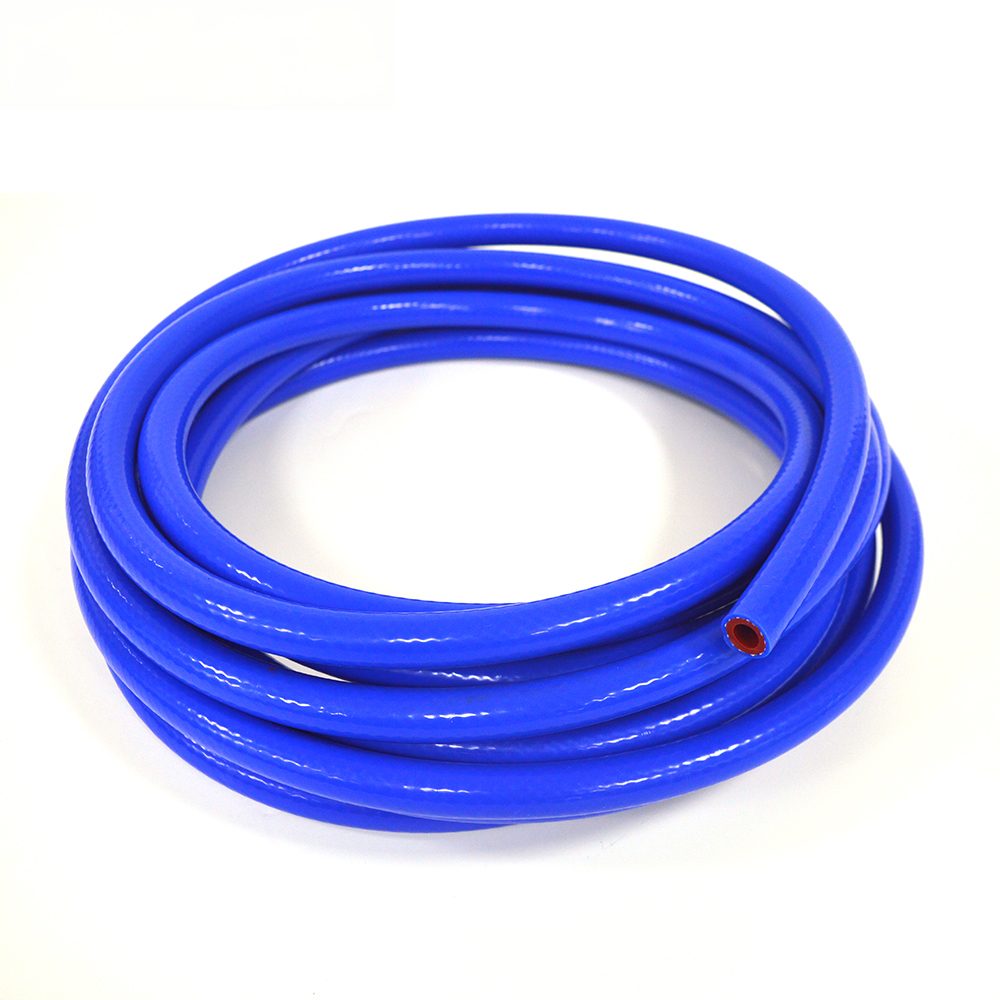
Silicone Hose
3. Temperature Resistance: Silicone Usually Has the Wider Range
If temperature is the only selection criterion, silicone generally has the advantage.
Typical material data show silicone extending to approximately 180–200°C for continuous service, while suitable EPDM compounds can reach around 120–150°C depending on formulation and service conditions.
But temperature rating should never be considered in isolation.
A hose operating at 140°C with hot water may have very different material requirements from a hose operating at 140°C with dry air, oil, steam, or chemicals.
For example:
- 140°C dry air: Silicone may be highly suitable.
- 140°C hot water: EPDM may be a strong option.
- 140°C saturated steam: A steam-rated EPDM formulation may be preferable to a general-purpose silicone hose.
- 140°C petroleum oil: Neither standard EPDM nor general-purpose silicone should automatically be selected.
This is why a material’s nominal maximum temperature is not enough to determine suitability.
4. EPDM vs Silicone for Steam and Hot Water
This is one of the most important differences between the two materials.
EPDM is widely used for hot-water and steam service because of its resistance to water, heat, ozone, and weathering. Suitable EPDM compounds can perform well in repeated hot-water and steam exposure.
Silicone can also handle hot water and certain steam applications, but its performance depends strongly on the formulation, pressure, temperature, and exposure duration.
For repeated saturated-steam service, particularly under demanding sterilization conditions, specialized EPDM grades can offer advantages over general-purpose silicone.
Therefore, if the application is primarily:
Hot water + steam + outdoor exposure → EPDM should be seriously considered.
If it is:
Dry heat + extreme temperature cycling + broad temperature range → Silicone may be more appropriate.
5. Mechanical Performance Matters Too
A high-temperature hose still needs to survive the mechanical conditions of the system.
Important factors include:
- Working pressure
- Pressure surges
- Minimum bend radius
- Vibration
- Repeated bending
- Abrasion
- Compression
- Hose routing
- Reinforcement construction
Silicone is highly flexible, but its mechanical strength and abrasion resistance may be lower than those of some EPDM constructions. EPDM can therefore be attractive where the hose is exposed to mechanical contact or demanding external conditions.
The reinforcement is also critical.
A reinforced hose can use textile layers or other reinforcement structures to improve pressure resistance and dimensional stability. Therefore, two hoses made from the same elastomer can have very different pressure capabilities.
For high-temperature applications, the complete hose construction—not just the rubber compound—must be evaluated.
6. A Practical Decision Guide
When choosing between EPDM and silicone for a high-temperature hose, use this checklist:
Choose EPDM when:
- The main medium is water, hot water, steam, or coolant.
- Outdoor weather resistance is important.
- Ozone and UV exposure are significant.
- Abrasion resistance is important.
- The required temperature is within the selected EPDM grade’s rating.
- Cost efficiency is an important consideration.
Choose silicone when:
- Continuous temperature is beyond the practical range of the selected EPDM grade.
- The application involves severe thermal cycling.
- Very low-temperature flexibility is also required.
- High-temperature air transfer is involved.
- A suitable food, medical, or pharmaceutical-grade material is required.
Consider another material when:
- The hose carries petroleum oils or fuels.
- Aggressive chemicals are involved.
- Very high temperature and chemical resistance are required simultaneously.
In these cases, materials such as NBR, FKM, PTFE, or specialized compounds may need to be evaluated instead.
Conclusion: EPDM or Silicone—Which Is Better?
There is no universal winner between EPDM and silicone hose.
Silicone generally has the advantage when the primary challenge is extreme temperature, broad temperature cycling, or low-temperature flexibility.
EPDM can be the better solution when high temperature is combined with hot water, steam, coolant, outdoor exposure, ozone, or weathering.
For high-temperature hose applications, Utigoflex provides different hose materials and constructions to match specific operating requirements rather than treating temperature as the only selection criterion.
[Contact Utigoflex Today] to request a specialized quote or download our complete technical assembly catalog.

