You are here: Home1 / Resource2 / Technical Guidance3 / About Hose Types: Quick Guide to Hydraulic Hose
Hydraulic Hoses Guide: 5 Essential Types to Boost Industrial Efficiency
Introduction to Hydraulic Hoses
Choosing the right hydraulic hoses is key to ensuring safe and efficient fluid transfer in industrial systems. These flexible tubes are designed to carry high-pressure fluids and are widely used in construction, agriculture, and manufacturing.
At Utigoflex, we specialize in providing high-quality hydraulic hose solutions that meet global standards and deliver long-term performance.
Understanding the Types of Hydraulic Hoses
1. Braided Steel Wire Hydraulic Hose
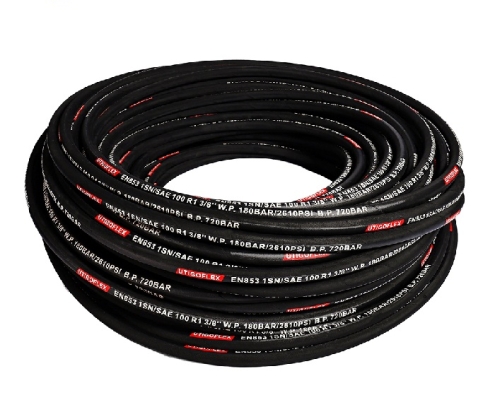
SAE 100 R1 / DIN EN 853 1SN
This type of hydraulic hose is the most widely used in modern industry and is typically constructed from one or two layers of high-strength steel wire braiding (e.g., in accordance with the EN 853 1SN/2SN standard).
Advantages:
Excellent flexibility, small bending radius, and easy installation in confined spaces; lightweight and cost-effective.
Disadvantages:
Limited pressure-bearing capacity. When the braided layer is subjected to uneven stress or frequent pulsating impacts, its fatigue life is shorter than that of spiral-wound hoses.
Typical Applications:
- Agricultural Machinery: Auxiliary hydraulic systems for tractors and harvesters.
- Low- and Medium-Pressure Industrial Hydraulics: Oil supply lines for forklifts, lifting platforms, and machine tools.
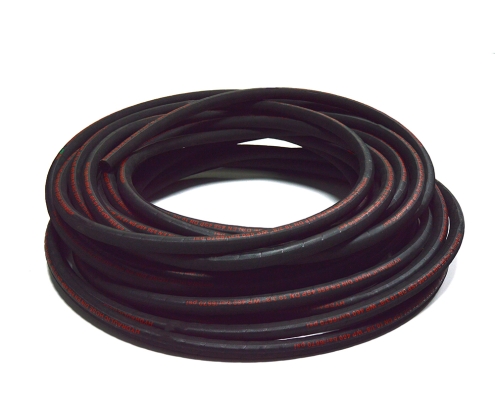
2. Spiraled Steel Wire Hydraulic Hose
Designed specifically for extreme high-pressure and heavy-duty applications, these hoses typically feature 4 or 6 layers of helically wound steel wire (e.g., EN 856 4SP/4SH standard).
Advantages:
Exceptional resistance to high pressure and pulsation. The parallel, helical arrangement of the steel wire provides superior resistance to sudden pressure surges.
Disadvantages:
The hose is heavy and very rigid, has a large bending radius (difficult to bend), is challenging to install, and is expensive.
Typical Applications:
- Heavy-duty construction machinery: Main pump oil lines for excavators, tunnel boring machines.
- Mining equipment: High-power hydraulic supports in European underground mines.
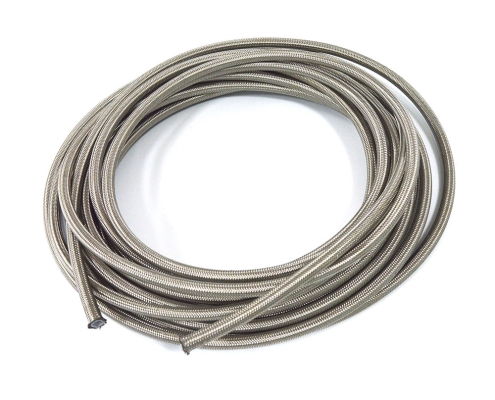
3. Thermoplastic Hydraulic Hose
The internal structure typically consists of a polyester or nylon inner tube, a middle layer of synthetic fiber braiding, and an outer layer of polyurethane (e.g., SAE 100 R7/R8).
Advantages:
- Chemical resistance: Capable of conveying many special fluids that are incompatible with mineral oils.
- Non-conductivity: Special models can be used in electrical applications (good insulation).
- Weather resistance: Minimal inner diameter tolerance, extremely lightweight, and abrasion-resistant outer jacket.
Disadvantages:
Strong shape memory after bending (less flexible than rubber hoses), and high-temperature resistance is generally lower than that of rubber hoses.
Typical Applications:
- Aerial work platforms: Insulated hoses protect the safety of electrical maintenance workers.
- Hydraulic tools: Portable hydraulic shears and jacks.
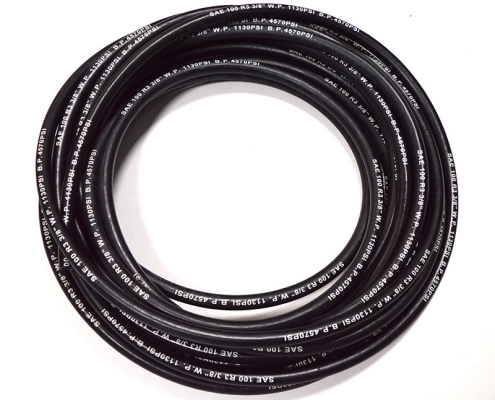
4. Braided Textile Hydraulic Hose
Typically reinforced with one or more layers of synthetic fiber (such as nylon or polyester) (e.g., SAE 100 R3/R6).
Advantages:
Extremely lightweight, excellent flexibility, and lowest cost. Unlike steel wire hoses, they are not prone to internal fatigue failure, and steel wire corrosion does not occur.
Disadvantages:
Can only be used in low-pressure or return systems; cannot withstand high-impact forces.
Typical Applications:
- Return Lines: Low-pressure return sections in industrial hydraulic systems.
- Pneumatic and Vacuum Systems: Air transport or water-air mixed fluids.
How to Choose the Right Hydraulic Hose for Your Project ?
Before you place an order, evaluate these four key factors:
- Pressure Rating: Does the hose meet the maximum working pressure of your system?
- Temperature Range: Can it withstand both the ambient external temperature and the fluid temperature?
- Fluid Compatibility: Is the hose material resistant to the specific chemicals or oils you are transporting?
- Flexibility Needs: How much movement or bending will the hose undergo during operation?
Why Partner with Utigoflex?
In the competitive world of industrial manufacturing, your supplier should be more than just a vendor—they should be a partner. Utigoflex stands out by offering reliable, customizable hydraulic hose solutions tailored for global industries.
We understand that downtime costs money. That’s why our products are designed for long-term reliability and performance. When you choose Utigoflex, you are choosing expert manufacturing and a commitment to safety.

