
• Facebook
  • Youtube
  • Instagram
  • WhatsApp
Give us a call now: 13510833230
Utigoflex
  • Home
  • About Us
    • Certification
  • Product
    • Hydraulic Hose
      • Braided Steel Wire Hydraulic Hose
        • SAE 100 R1 / DIN EN 853 1SN
        • SAE 100 R2 AT / DIN EN 853 2SN
        • SAE 100 R5 Steel Wire Braided Hydraulic Hose
        • SAE 100 R16 Steel Wire Braided Hydraulic Hose
        • SAE 100 R17 Steel Wire Braided Hydraulic Hose
        • EN 857 1SC Steel Wire Braided Hydraulic Hose
        • EN 857 2SC Steel Wire Braided Hydraulic Hose
      • Spiraled Steel Wire Hydraulic Hose
        • SAE 100 R9 Steel Wire Spiraled Hydraulic Hose
        • SAE 100 R12 Steel Wire Spiraled Hydraulic Hose
        • SAE 100 R13 Steel Wire Spiraled Hydraulic Hose
        • SAE 100 R15 Steel Wire Spiraled Hydraulic Hose
        • EN 856 4SH Steel Wire Spiraled Hydraulic Hose
        • EN 856 4SP Steel Wire Spiraled Hydraulic Hose
      • Thermoplastic Hydraulic Hose
        • SAE 100 R7 Thermoplastic Hydraulic Hose
        • SAE 100 R8 Thermoplastic Hydraulic Hose
        • SAE 100 R14 Stainless Steel Wire Braided with PT
      • Braided Textile Hydraulic Hose
        • SAE 100 R3
        • SAE 100 R4 Textile Braided Hydraulic Hose
        • SAE 100 R6
        • EN 854 1TE/2TE/3TE Textile Braided Hydraulic Hose
    • Rubber Hose
      • EPDM Air & Water Hose
      • Chemical Suction & Discharge Hose
      • Steam Hose
      • Fuel & Diesel Delivery Hose
      • Fuel & Diesel Suction Hose
      • LPG/CNG Rubber Hose
      • Drilling Hose
      • Air Compressor Hose
      • High pressure Washing Hose
      • Marine High Pressure Oil Conveying Hose
      • Sand Blast Rubber Hose
      • Suction & Discharge Hose
      • Concrete Delivery Hose
      • Composite Hose
      • Food Grade Hose
      • EPDM Hot Water Hose
      • Stainless Steel Flexible Hose
    • PVC Hose
      • PVC Garden Hose
      • PVC Layflat Hose
      • Multi–Purpose PVC Air Hose – Matt Surface
      • Multi–Purpose PVC Air Hose – Shining Surface
      • Smooth Surface PVC Steel Wire Hose
      • PVC Fiber Hose
      • PVC High Pressure Spray Hose
      • PVC Corrugated Suction Hose
      • PVC Grit Hose
      • PVC Kink–Proof Suction Hose
      • PVC Interlocked Hose
      • Fuel Drop Hose
    • Industrial Hose
      • ANFO Explosive Loading Hose
      • Air Hose
      • Fuel & Oil Delivery Hose
      • Chemical Hose
      • Layflat Fire Hose
      • Welding Hose
      • High Pressure Spray Hose
      • PU Suction Hose
      • PU Anti Static Suction Hose
      • PU Step Hose
      • Polypropylene Drain Hose
    • Air Duct Hose
      • PU Air Duct
      • PU Air Duct With Black Strip
      • PVC Air Duct
      • TPR (TPE) Air Duct
      • TPR (TPE) Air Duct With Green Strip
      • Silicone Coated Glass Fiber Duct
      • Portable Ventilation Duct
      • Clamped High Temperature Duct
      • Clamped Polyester Duct
      • Clamped Tarpaulin Duct
      • EPDM Fume Exhaust Hose
    • Food Grade Hose
      • Food Grade Rubber Hose
      • Smooth Surface PVC Spiral Hose
      • Smooth Surface PVC Steel Wire Hose
      • PVC Fiber Hose
    • Pneumatic Hose
      • Nylon tubing
      • PU Pneumatic Hose
    • Hydraulic Fittings
    • Hose Camlocks
    • Hose Clamps
    • Crimping/Cutting Machine
      • Crimping Machine
      • Cutting Machine
    • Rubber Sheet
  • Services
    • Agriculture Hose Solution
    • Construction Hose Solution
    • Oil & Fuel Hose Solution
    • Chemical Industry Hose Solutions
    • Mining Hose Solution
    • Food Grade Hose Solution
  • Resources
    • Download Center
    • Technical Guides
    • Blog
      • Product Knowledge
      • Company News
  • Contact Us
  • Search
  • Menu Menu
You are here: Home1 / Resource2 / Technical Guidance3 / High Pressure Hose Buying Guide: Key Factors to Consider Before Purcha...

High Pressure Hose Buying Guide: Key Factors to Consider Before Purchase

With the continuous development of the industrial sector, the demand for high-pressure hoses has been steadily rising. They can be found in both visible and hidden applications, such as hydraulic systems, high-pressure washers, automotive applications, and various types of industrial machinery.

Utigoflex has observed that some of our customers mistakenly assume that rubber hoses are high-pressure hoses, when in fact not all rubber hoses are suitable for high-pressure environments. Using hoses that do not meet the necessary specifications can lead to hose rupture, system damage, or even more serious safety incidents.

Therefore, drawing on our past client cases and experience, this guide provides a comprehensive overview of the differences to help you select the appropriate hose for your specific application.

What Is a High Pressure Hose?

High-pressure hoses do not refer to a specific type of hose, but rather to flexible tubing designed to transport fluids (such as oil, water, or air) in high-pressure environments. Structurally, they feature a multi-layered reinforced design that enables them to withstand greater pressure and prevent rupture

What are the structural differences in high-pressure hoses?

High-pressure hoses typically consist of a three-layer structure: the inner tube, the reinforcement layer, and the protective layer.

1. Inner Tube

As the innermost layer of the high-pressure hose, it is the part that comes into direct contact with the fluid. Therefore, the material of the inner tube must be compatible with the conveyed fluid medium—that is, it must not interact with the fluid to cause contamination or hose degradation. Typically, the inner tube possesses anti-swelling and anti-degradation properties.
Common materials for the inner tube include: nitrile rubber (oil-resistant), EPDM rubber (hot water-resistant), PTFE (resistant to highly corrosive chemicals), or thermoplastic materials.

2. Reinforcement Layer

The pressure resistance of high-pressure hoses depends on the reinforcement layer, which is also one of the key differences between them and standard hoses. Common reinforcement layers include textile braided layers (suitable for lower pressures, such as 1,000–3,000 PSI), single-layer steel wire braided layers (suitable for medium pressures, such as 3,000–5,000 PSI), and double-layer or spiral steel wire layers (suitable for high pressures, such as 6,000–10,000+ PSI). In theory, the more layers of steel wire, the higher the pressure rating of the hose.

3. Outer Cover

Since high-pressure hoses are typically used in extreme operating environments, a protective layer is added to extend their service life and minimize the impact of environmental factors on their performance. This layer is usually made of synthetic rubber or polyurethane and is designed to resist abrasion, weathering, oil contamination, and UV damage.

Pressure Ratings You Must Understand

When selecting high-pressure hoses, users are often confused by two pressure terms: working pressure and burst pressure. What do these terms mean?

  • Working Pressure: This refers to the maximum pressure the hose can withstand continuously over an extended period. It is a critical parameter that helps customers select the appropriate hose for their specific application.
  • Burst Pressure: This refers to the maximum instantaneous pressure the hose can withstand under extreme conditions.

It is important to note that if a hose operates for extended periods at pressures exceeding its working pressure or approaching its burst pressure, its service life will be drastically shortened, and it may even fail suddenly.

Common Types of High Pressure Hoses

1. Hydraulic Hoses (SAE 100R Series)

The most common high pressure hoses in industry.
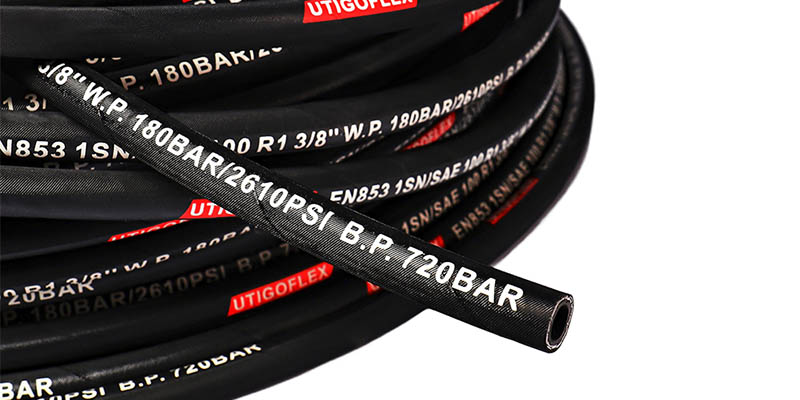
SAE 100 R1 Hydraulic Hose

  • SAE 100R1: Single wire braid (medium pressure).
  • SAE 100R2: Double wire braid (higher pressure).
  • SAE 100R12 / R13: Four or six spiral wire layers (ultra-high pressure, impulse-resistant).

2. Thermoplastic Hoses

Lighter, more flexible, and resistant to chemicals. Often used for high-pressure water or pneumatic systems (up to 5,000+ PSI).
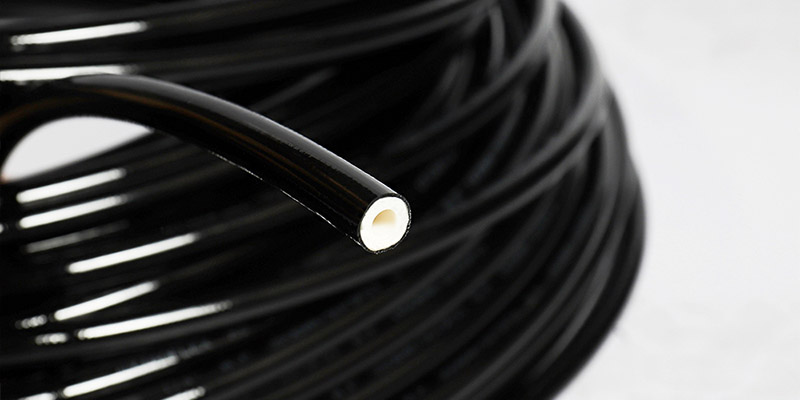
SAE 100 R7 Thermoplastic Hydraulic Hose

3. PTFE (Teflon) Hoses

Virtually chemically inert and extremely temperature resistant. Used for aggressive fluids, steam, or high-purity applications. Pressure ratings typically from 1,000 to 5,000 PSI.

4.  High Pressure Washing Hoses

Designed specifically for hot or cold water at 1,500–4,000+ PSI. Usually feature non-marking covers and durable fittings.
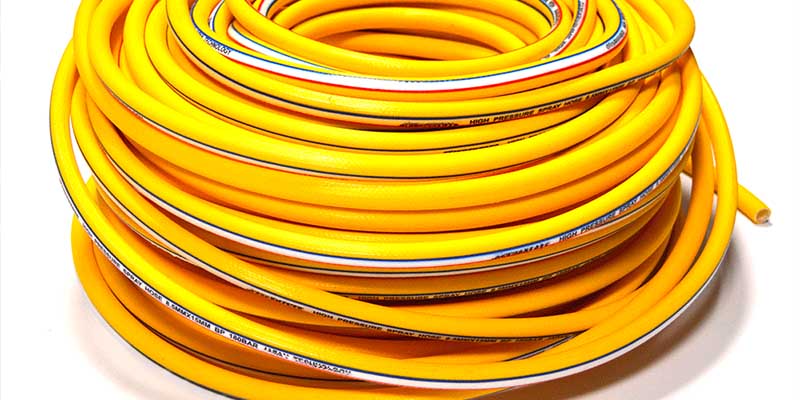
PVC High Pressure Spray Hose

Safety: The Dangers of High Pressure Hoses

High pressure hoses are not forgiving. Here are the three biggest risks:

1. Fluid Injection Injuries

If a high pressure hose develops a pinhole leak, the fluid can shoot through your skin with enough force to require amputation.

  • Signs of a dangerous leak: A mist or spray coming from the hose cover, or a hose that feels soft in one spot.
  • Never use your hand to check for leaks. Use a piece of cardboard or wood.

2. Hose Whipping

If a fitting fails under pressure, the hose can whip violently, striking workers with tremendous force. Always use whip checks (safety cables) on hydraulic hoses.

3. Abrasion and Heat Damage

Rubbing against machinery or exposure to hot surfaces can weaken the reinforcement layer without visible external damage.

How to Choose the Right High Pressure Hose

1. What fluid are you transferring?

  • Oil / hydraulic fluid → Nitrile tube (SAE 100R series)
  • Water / hot water → EPDM tube
  • Chemicals / solvents → PTFE or UHMWPE tube
  • Air → Thermoplastic or specialty air hose (never use a hydraulic hose for air unless rated)

2. What is the maximum working pressure?

Add a safety margin. If your system runs at 2,500 PSI, buy a hose rated for 3,000 PSI or higher.

3. What is the temperature range?

Standard rubber hoses handle -40°F to 212°F. For higher temperatures, upgrade to PTFE or specialty high-temp rubber.

4. What size do you need?

High pressure hoses are measured by inner diameter (ID) . Common sizes range from 1/4″ to 2″. A larger ID reduces pressure drop but requires larger fittings.

5. What fitting style?

  • Permanent crimp fittings (factory-made, reliable)
  • Reusable fittings (field-assembled, convenient for repairs)
  • Hose camlocks (for frequent connection changes)

Maintenance Tips for Long Life

  1. Inspect regularly: Look for cuts, bulges, abrasion, or leaking fittings.
  2. Replace on schedule: Even without visible damage, rubber hoses age. Typical replacement interval: 1–2 years in heavy use.
  3. Store properly: Keep away from ozone, UV light, and extreme heat. Use hose reels or racks.
  4. Do not over-bend: Every hose has a minimum bend radius. Bending tighter than this will kink the reinforcement and weaken the hose.

Conclusion

Choosing the right high-pressure hose isn’t just a purchase decision—it directly safeguards your operational safety, reduces downtime, and protects your entire hydraulic system from avoidable damage. Many buyers overlook critical specifications and end up with hoses that fail prematurely, cause safety risks, or lead to costly system breakdowns.

At Utigoflex, we combine years of industry expertise and real on-site application experience to help you avoid these mistakes. By understanding hose structure, pressure ratings, fluid compatibility, and proper selection criteria, you can invest in hoses that perform reliably under extreme conditions and deliver long-term value.

Regular maintenance and correct usage will further extend service life and keep your operations running smoothly. Whether you need hydraulic hoses, high-pressure washing hoses, thermoplastic hoses, or PTFE hoses, we offer professional, durable solutions tailored to your exact working environment.
Make the right choice today with Utigoflex high-pressure hoses—secure safer operations, stable performance, and lower long-term costs for your business.

About Utigoflex Contact Us
byadministratorKathy/April 10, 2026/inTechnical Guidance

Recent
  • High Pressure Hose Buying GuideHigh Pressure Hose Buying Guide: Key Factors to Consider...April 10, 2026 - 9:21 am
  • Fuel Hose vs. Chemical HoseFuel & Diesel Suction Hoses vs. Chemical Suction &...April 9, 2026 - 9:32 am
  • 4SP vs 4SH Hydraulic HoseHow to Select Hydraulic Hose: 4SP vs 4SH Hydraulic HoseApril 3, 2026 - 3:28 am
  • A Detailed Guide to Hydraulic Hose StandardsA Detailed Guide to Hydraulic Hose Standards: SAE, EN, ...March 27, 2026 - 9:16 am
  • A Quick Guide to Hydraulic HoseAbout Hose Types: Quick Guide to Hydraulic HoseMarch 26, 2026 - 2:49 am
  • A Quick Guide to PVC HosesAbout Hose Types: A Quick Guide to PVC HosesMarch 20, 2026 - 9:17 am
  • A Quick Guide to Industrial HosesAbout Hose Types: A Quick Guide to Industrial HosesMarch 20, 2026 - 6:33 am
  • How to Select Hydraulic Hoses: Steel Wire Braided vs. Textile...March 18, 2026 - 9:47 am
Popular
  • Engineering PlasticsApril 18, 2024 - 9:54 am
  • Factory informationApril 18, 2024 - 9:58 am
  • Hydraulic hose workshopApril 18, 2024 - 10:00 am
  • Hydraulic hosesApril 18, 2024 - 10:01 am
  • Packaging & WarehouseApril 18, 2024 - 10:01 am
  • Production lineApril 18, 2024 - 10:02 am
  • Layflat Discharge Hoses: The Future of Lightweight Fluid...October 24, 2025 - 9:43 am
  • How to Choose the Right Industrial Hose for Your Applic...March 20, 2025 - 2:18 am
Comments
  • Awaiting check payment Order status changed from Pending...December 19, 2022 - 2:54 am by WooCommerce
  • Awaiting check payment Order status changed from Pending...December 12, 2022 - 2:14 pm by WooCommerce
  • Awaiting check payment Order status changed from Pending...December 12, 2022 - 1:37 pm by WooCommerce
  • Order cancelled by customer. Order status changed from Pending...November 16, 2022 - 11:59 am by WooCommerce
  • Awaiting check payment Order status changed from Pending...October 30, 2022 - 7:20 am by WooCommerce
  • Unpaid order cancelled - time limit reached. Order status...October 14, 2022 - 8:46 am by WooCommerce
  • Unpaid order cancelled - time limit reached. Order status...September 6, 2022 - 7:40 pm by WooCommerce
  • Awaiting check payment Order status changed from Pending...September 6, 2022 - 5:49 pm by WooCommerce
Tags

Categories

  • Blog
  • Company News
  • Product Knowledge
  • Technical Guidance
  • Uncategorized
  • Facebook
  • X
  • LinkedIn
  • Youtube
  • Instagram
  • steven@utigoflexhose.com
  • FACEBOOK
  • Instagram
  • YOUTUBE
  • 13510833230

Company

    • About Us
    • Products
    • Resources
    • Contact Us

Product

  • Hydraulic Hose
  • Rubber Hose
  • PVC Hose
  • Industrial Hose
  • Air Duct Hose
  • Food Grade Hose
  • Pneumatic Hose

Technical Support

    • Plastic Hoses Catalogue
    • Rubber Hose Catalogue
    • Hydraulic Fittings Catalogue
    • Privacy Policy

Follow Us

Copyright @ Utigoflex | All rights reserved
Fuel & Diesel Suction Hoses vs. Chemical Suction & Discharge Hose:...Fuel Hose vs. Chemical Hose
Scroll to top

This site uses cookies. By continuing to browse the site, you are agreeing to our use of cookies.

Agree & ContinueSettingsReject

Cookie and Privacy Settings


How we use cookies

We may request cookies to be set on your device. We use cookies to let us know when you visit our websites, how you interact with us, to enrich your user experience, and to customize your relationship with our website.

Click on the different category headings to find out more. You can also change some of your preferences. Note that blocking some types of cookies may impact your experience on our websites and the services we are able to offer.

Essential Website Cookies

These cookies are strictly necessary to provide you with services available through our website and to use some of its features.

Because these cookies are strictly necessary to deliver the website, refusing them will have impact how our site functions. You always can block or delete cookies by changing your browser settings and force blocking all cookies on this website. But this will always prompt you to accept/refuse cookies when revisiting our site.

We fully respect if you want to refuse cookies but to avoid asking you again and again kindly allow us to store a cookie for that. You are free to opt out any time or opt in for other cookies to get a better experience. If you refuse cookies we will remove all set cookies in our domain.

We provide you with a list of stored cookies on your computer in our domain so you can check what we stored. Due to security reasons we are not able to show or modify cookies from other domains. You can check these in your browser security settings.

Google Analytics Cookies

These cookies collect information that is used either in aggregate form to help us understand how our website is being used or how effective our marketing campaigns are, or to help us customize our website and application for you in order to enhance your experience.

If you do not want that we track your visit to our site you can disable tracking in your browser here:

Other external services

We also use different external services like Google Webfonts, Google Maps, and external Video providers. Since these providers may collect personal data like your IP address we allow you to block them here. Please be aware that this might heavily reduce the functionality and appearance of our site. Changes will take effect once you reload the page.

Google Webfont Settings:

Google Map Settings:

Google reCaptcha Settings:

Vimeo and Youtube video embeds:

Other cookies

The following cookies are also needed - You can choose if you want to allow them:

Privacy Policy

You can read about our cookies and privacy settings in detail on our Privacy Policy Page.

Privacy Policy
Accept settingsHide notification only
Skip to content
Open toolbar Accessibility Tools

Accessibility Tools

  • Increase TextIncrease Text
  • Decrease TextDecrease Text
  • GrayscaleGrayscale
  • High ContrastHigh Contrast
  • Negative ContrastNegative Contrast
  • Light BackgroundLight Background
  • Links UnderlineLinks Underline
  • Readable FontReadable Font
  • Reset Reset