
What Is a PVC Fibre Reinforced Suction Hose?
What Is a PVC Fibre Reinforced Suction Hose?
A PVC fibre reinforced suction hose is a flexible hose made from polyvinyl chloride (PVC) and reinforced with textile fibres to improve strength and pressure resistance. It is commonly used for water transfer, irrigation, construction, and general industrial fluid handling.
Compared with an unreinforced PVC tube, the fibre reinforcement helps reduce expansion under internal pressure and improves dimensional stability. The hose also offers convenient handling, making it suitable for applications requiring flexibility and economical fluid transfer.
However, not every fibre reinforced PVC hose is suitable for heavy-duty suction. Applications involving strong vacuum pressure may require a hose with a rigid PVC helix or steel wire reinforcement. Buyers should always confirm the manufacturer’s vacuum rating before selecting a hose for pump-inlet service.

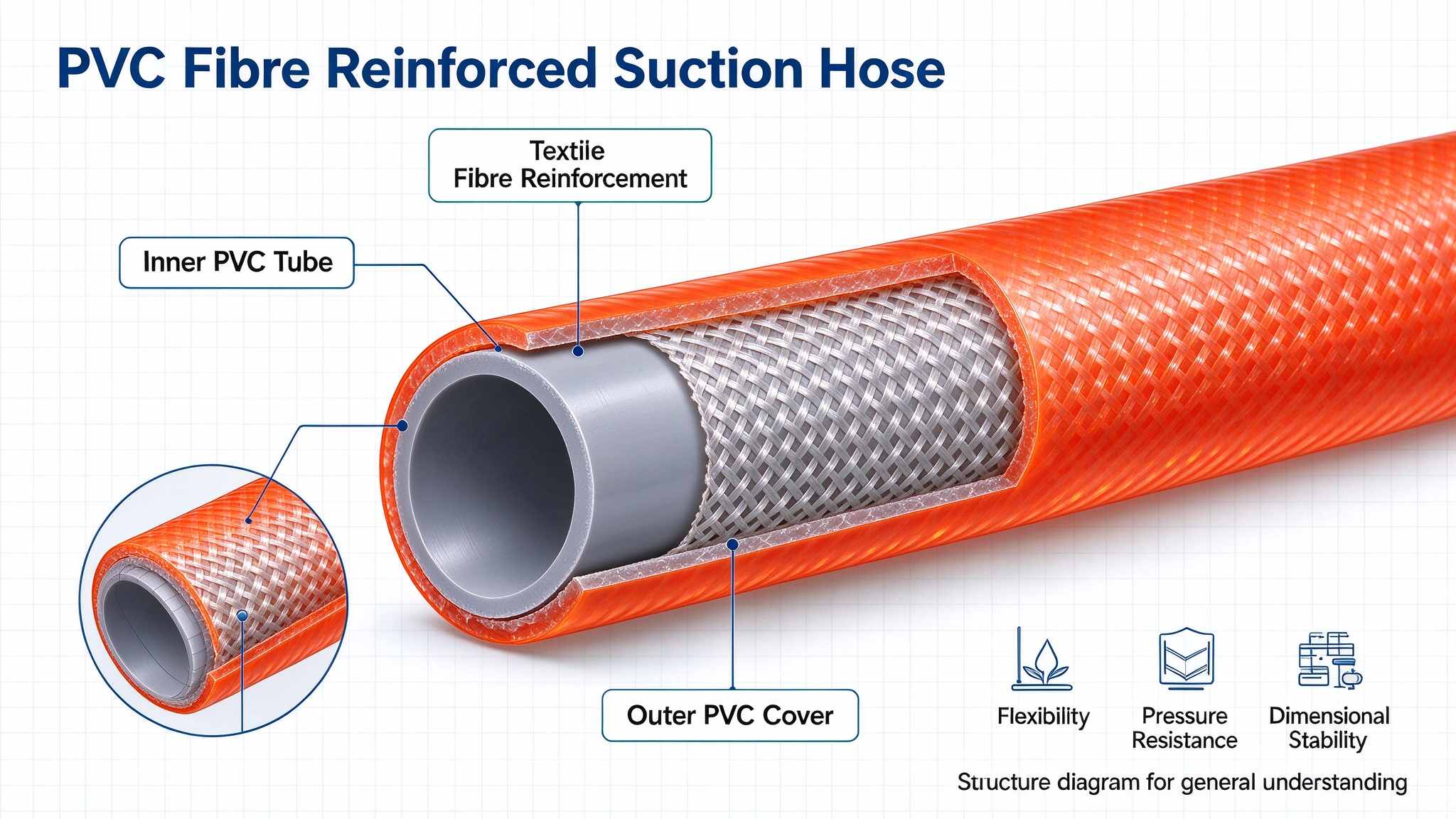
How Is a PVC Fibre Reinforced Suction Hose Constructed?
A typical PVC fibre reinforced hose consists of three main components.
1. Inner PVC Tube
The inner tube provides a smooth surface for fluid flow. PVC offers flexibility, corrosion resistance, and cost efficiency for many water-transfer applications.
Its suitability for chemicals, oils, and other liquids depends on the PVC formulation, fluid concentration, and operating temperature.
2. Textile Fibre Reinforcement
The reinforcement layer is typically made from polyester or another suitable synthetic fibre. Integrated into the hose wall, it helps the hose withstand internal pressure and reduces excessive expansion during operation.
The reinforcement structure and manufacturing quality influence the hose’s pressure performance. However, textile reinforcement alone does not guarantee resistance to vacuum-induced collapse.
3. Outer PVC Cover
The outer PVC layer protects the reinforcement against moisture, ordinary wear, and external damage. Its durability depends on the material formulation and working environment.
Together, these layers provide a balance of flexibility, strength, and affordability.
What Are the Key Features of a PVC Fibre Reinforced Suction Hose?
PVC fibre reinforced hoses offer several advantages for general-purpose fluid handling.
- Flexibility:The hose can be routed around equipment and installed in various layouts.
- Pressure resistance:Textile reinforcement helps limit expansion under internal pressure.
- Lightweight construction:Compared with many rigid piping systems, the hose is easier to handle and transport.
- Corrosion resistance:PVC is suitable for many water-based applications and compatible fluids.
- Easy maintenance:The hose can be inspected visually for cracks, bulges, abrasion, and exposed reinforcement.
- Cost efficiency:PVC materials provide a practical solution for many routine fluid-transfer requirements.
These benefits make the hose useful for everyday industrial applications. Nevertheless, its working pressure, temperature range, and vacuum capability must be checked against the manufacturer’s specifications.
Where Is a PVC Fibre Reinforced Suction Hose Used?
Agriculture and Irrigation
In agricultural operations, these hoses can transfer water between tanks, pumps, and irrigation equipment, provided their pressure and suction ratings meet system requirements. Their flexibility is especially useful when equipment needs to be moved between locations.
Construction Sites
Construction projects often require temporary water supply, equipment cleaning, and general water transfer. A reinforced PVC hose offers convenient handling and installation.
For abrasive slurry, gravel, or heavy sediment, a dedicated abrasion-resistant suction hose may be more appropriate.
Industrial Fluid Transfer
Factories and workshops may use these hoses for water circulation, equipment washing, and other compatible liquid-transfer tasks. Before use, operators should confirm chemical compatibility and operating temperature.
Commercial and General-Purpose Applications
Maintenance facilities and commercial operations can also benefit from flexible PVC hoses for routine water delivery and fluid handling.
Utigoflex provides hose solutions for different industrial applications. Selecting the correct construction requires understanding the operating conditions rather than relying on the product name alone.
How to Choose the Right PVC Fibre Reinforced Suction Hose
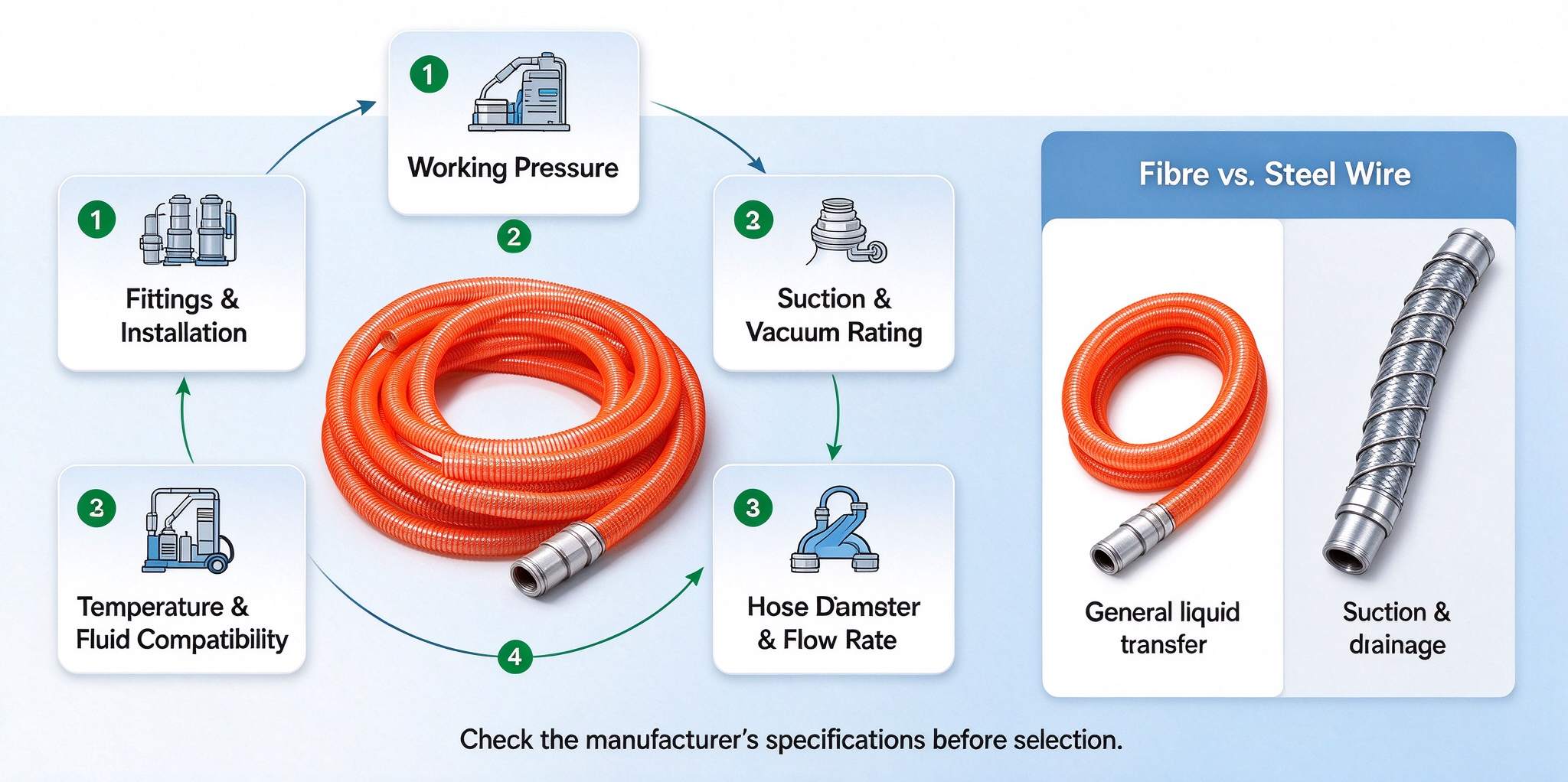
Choosing a suitable hose involves several important considerations.
1. Working Pressure
Determine the maximum operating pressure, including foreseeable fluctuations. Select a hose rated for the actual operating conditions, and never treat burst pressure as the normal working limit.
2. Suction and Vacuum Requirements
If the hose is installed on a pump inlet, negative internal pressure may cause an inadequately supported hose to collapse.
Check the manufacturer’s vacuum rating. For demanding suction applications, consider a hose with rigid helical reinforcement specifically designed to resist collapse.
3. Hose Diameter and Flow Rate
The inner diameter affects fluid velocity and pressure loss. An undersized hose may restrict flow and increase pump load, while an oversized hose may increase costs unnecessarily.
Choose the diameter according to the required flow rate, hose length, fluid properties, and pump specifications.
4. Temperature and Fluid Compatibility
PVC properties change with temperature. High temperatures may soften the material, while low temperatures can reduce flexibility.
Confirm that the hose is compatible with the transferred liquid at its actual concentration and operating temperature. Standard PVC should not be assumed suitable for every oil, solvent, or chemical.
5. Fittings and Installation
The complete hose assembly must be suitable for the application. Check fitting compatibility, connection security, and any applicable pressure requirements.
Avoid sharp bends, twisting, excessive pulling, and unsupported connections that place unnecessary stress on the hose.
Before finalizing a specification, Utigoflex recommends evaluating the complete operating environment to ensure that the selected hose meets the application’s requirements.
PVC Fibre Reinforced Hose vs. PVC Steel Wire Reinforced Hose
Although both hoses use PVC, their reinforcement structures serve different purposes.
| Comparison | Fibre Reinforced PVC Hose | Steel Wire Reinforced PVC Hose |
| Reinforcement | Textile fibres | Steel wire helix |
| Main function | Improves internal pressure resistance | Provides structural support against collapse |
| Flexibility | Generally flexible | Depends on wire design and construction |
| Typical applications | General liquid transfer and water delivery | Suction, drainage, and industrial transfer |
| Vacuum performance | Depends on the product rating | Often better when specifically designed for suction |
Neither construction is automatically better for every application. A fibre reinforced hose may be sufficient for general liquid transfer, while a steel wire reinforced hose may be preferable when vacuum resistance is essential.
Always compare the manufacturer’s specifications with the actual operating requirements.
Conclusion
A PVC fibre reinforced suction hose is a practical solution for many general-purpose fluid-transfer applications. Its flexible PVC construction and textile reinforcement provide convenient handling, improved pressure resistance, and cost efficiency.
To choose the right product, evaluate working pressure, vacuum requirements, diameter, fluid compatibility, temperature, and fittings.
Need Help Choosing the Right Industrial Hose?
Utigoflex can help buyers evaluate hose solutions for different industrial requirements. Contact your supplier with your application details to identify a suitable hose construction for reliable fluid transfer.
[Contact Utigoflex Today] to request a specialized quote or download our complete technical assembly catalog.
