You are here: Home1 / Blog2 / Product Knowledge3 / How to Choose Hydraulic Hose Size | ID, OD & Flow Guide
How to Choose the Right Hydraulic Hose Size: A Professional Guide
Selecting the correct hydraulic hose size is critical for system performance, safety, and service life. An incorrectly sized hose can lead to excessive pressure drops, overheating, component failure, or even catastrophic bursts. This guide provides a professional framework for making the right choice, incorporating industry best practices and the expertise of Utigoflex, a trusted provider of high-quality fluid transfer solutions since 2009.
1. Understand Key Dimensions: ID, OD, and Dash Size
Proper sizing begins with understanding the fundamental measurements of a hydraulic hose .
| Dimension | Definition | Why It Matters |
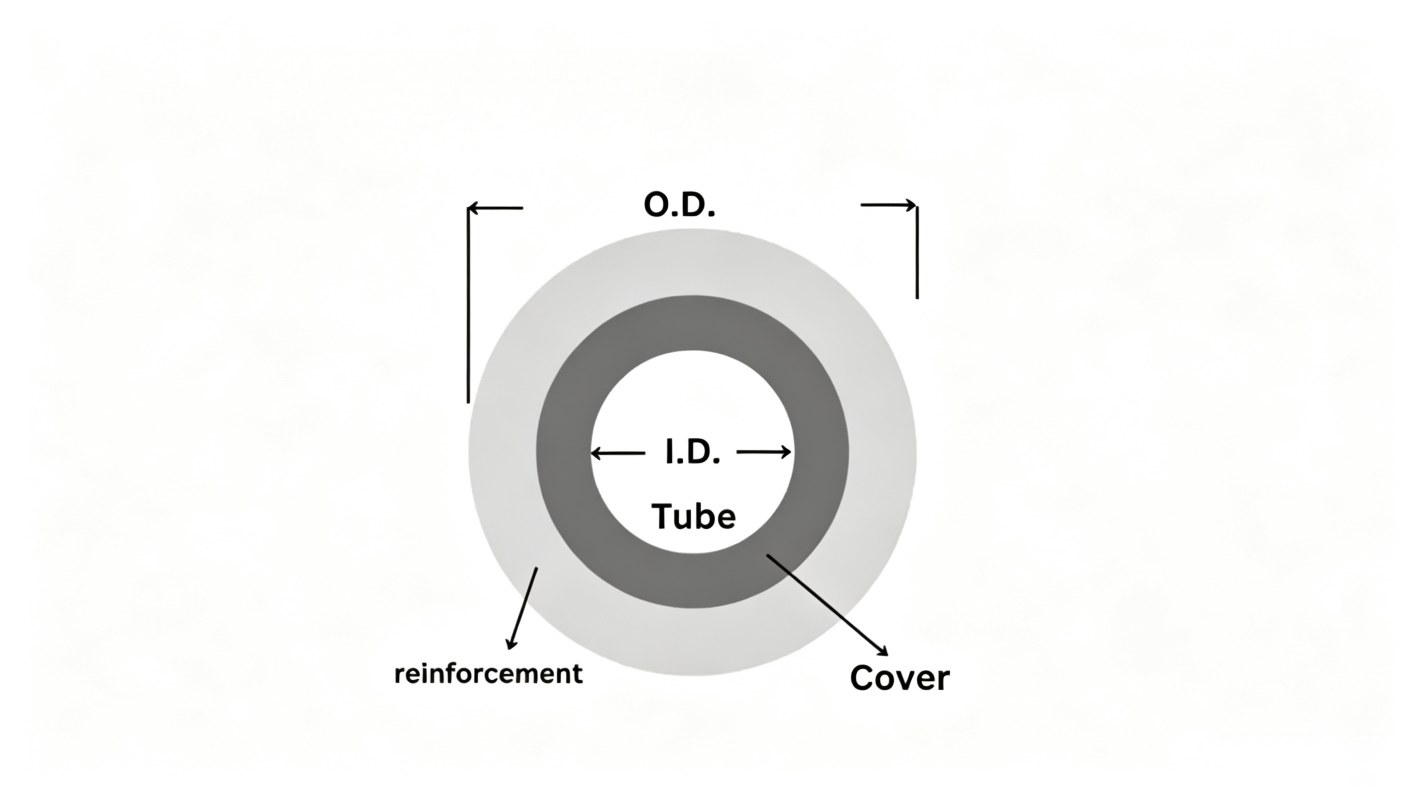
| Inner Diameter (ID) | The measurement of the space inside the hose cross-section . | Determines flow rate and fluid velocity. An undersized ID causes excessive friction, pressure drops, and heat generation. An oversized ID leads to sluggish system response and higher costs . |
| Outer Diameter (OD) | The total diameter of the hose, including the tube, reinforcement, and cover . | Critical for fitting compatibility, clamp sizing, and ensuring the hose fits within the physical space of the application . |
| Dash Size | A standardized numbering system where each number represents the ID in 1/16-inch increments (e.g., -8 = 8/16″ or 1/2″ ID) . | Ensures quick, consistent identification and compatibility between hoses and fittings across different manufacturers. |
2. Use the S.T.A.M.P.E.D. Method for Comprehensive Selection
The S.T.A.M.P.E.D. acronym is an industry-standard framework for evaluating all critical factors in hose selection .
“S” – Size
The inside diameter must be adequate to keep pressure loss to a minimum and avoid damage from heat generation due to excessive turbulence . Assembly length must also be measured, considering both the hose itself and attached fittings .
“T’ – Temperature
Consider both the fluid temperature and the ambient temperature. The hose must withstand the minimum and maximum extremes . Utigoflex offers hoses for extreme conditions, such as the SAE 100 R14 PTFE hose, which operates from -54°C to +204°C.
“A “– Application
Identify the operating conditions—high impulse, low impulse, flexing, or non-flexing applications .
“M” – Material/Media
Ensure compatibility of the hose tube, cover, fittings, and O-rings with the fluid being conveyed . Utigoflex’s SAE100 R7 and R8 thermoplastic hoses, for example, are compatible with hydraulic oils, water-based fluids, fuels, lubricants, air, and water .
“P” – Pressure
Determine the system’s maximum working pressure, including any pressure spikes. The published hose working pressure must be equal to or greater than this . For dynamic hydraulic applications, the minimum burst pressure rating is typically four times the maximum working pressure .
“E” – Ends
Select terminations based on working pressure, vibration resistance, and environmental factors. Always use manufacturer-approved ends and couplings .
“D” – Delivery
Consider any special quality, testing, cleanliness, packaging, and delivery requirements .
3. Apply Recommended Flow Velocity Guidelines
A key factor in sizing is ensuring the fluid velocity falls within recommended ranges. High velocities can cause tube erosion, while low velocities can lead to poor system response .
| Application | Recommended Velocity |
| Suction (Pump Intake) | Below 1.22 m/s (4 ft/s) to prevent cavitation . |
| Return Lines | Up to 3.05 m/s (10 ft/s) . |
| High-Pressure Lines | Up to 4.57 m/s (15 ft/s), but caution is needed with shock loads . |
Note: These velocities are based on a viscosity of 315 SSU at 100°F (37.8°C). Pressure losses can vary with temperature and viscosity .
4. Use a Nomographic Chart for Quick Sizing
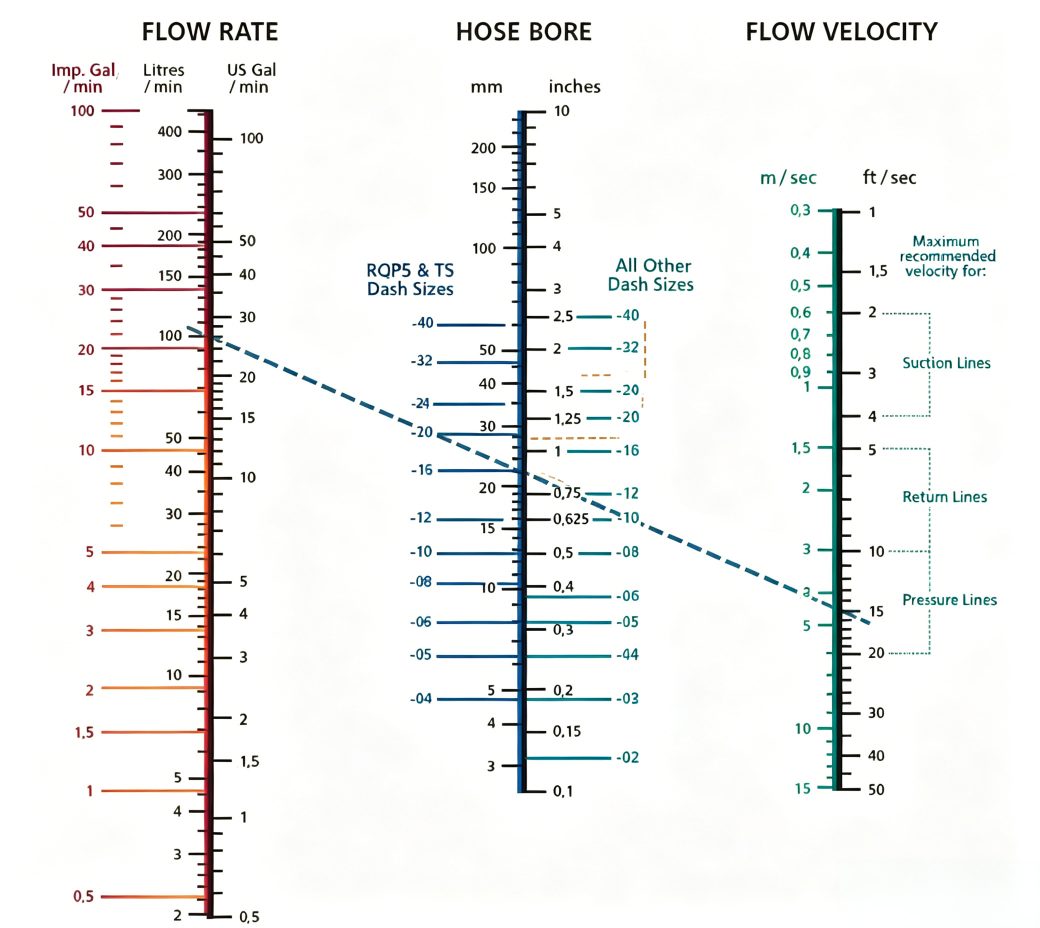
A nomographic chart is a visual tool that helps determine the required hose ID based on flow rate and recommended velocity .
How to use it:
Identify the system’s volumetric flow rate (in GPM or L/min) .
Determine whether the hose is for suction or discharge .
Lay a ruler across the chart, connecting the flow rate to the recommended velocity for the application .
The intersection point on the middle column indicates the recommended hose ID .
5. Avoid the Consequences of Incorrect Sizing
Undersized and oversized hoses each present significant risks:
Undersized ID: Causes excessive pressure drop, increased fluid temperature, fluid degradation, pump cavitation, reduced efficiency, and premature hose failure or bursting .
Oversized ID: Results in sluggish performance, higher costs, unnecessary weight, and difficult routing .
Conclusion
Selecting the right hydraulic hose size is not merely a technical detail—it is a fundamental decision that directly impacts your system’s efficiency, safety, and operational lifespan. By understanding critical dimensions like Inner Diameter (ID) and Outer Diameter (OD), following the comprehensive S.T.A.M.P.E.D. framework, and applying recommended flow velocity guidelines, you can avoid the costly consequences of incorrect sizing—from pressure drops and overheating to premature hose failure and unplanned downtime.
Build Your Safe Systems with Utigoflex
Utigoflex stands ready to support your hydraulic system needs with over a decade of experience and a full range of high-quality hoses, fittings, and assemblies.
Whether you need a standard solution or a custom-engineered assembly, Utigoflex delivers precision, durability, and global reliability. Choose the right size. Choose quality. Choose Utigoflex.
[Contact Utigoflex Today] to get hydraulic system solutions or download our complete technical assembly catalog.

