You are here: Home1 / Blog2 / Product Knowledge3 / How to Select Hydraulic Hose Fittings | Complete Guide by Utigoflex
How to Select the Right Fitting for Hydraulic Hoses: A Complete Practical Guide
Choosing the correct hydraulic hose fitting is critical for system safety, efficiency, and durability. A hose is only as strong as its weakest connection—so even a high-quality hose can fail if the fitting is wrong, poorly matched, or improperly installed.
This guide explains how to select the right fitting step by step, with practical recommendations from Utigoflex.
1. Match the Fitting to the Hose Standard
Hydraulic hoses and fittings must always be compatible with their governing standards. Even hoses that look identical can require different crimp specifications depending on whether they follow SAE or EN standards.
Hose vs Fitting Compatibility Overview
| Hose Standard | Example | Fitting Requirement |
| SAE Standard | SAE 100R2 | SAE-specific crimp specs |
| EN Standard | EN 853 2SN | EN-specific crimp specs |
| Dual Standard | SAE/EN certified hose | Approved matching fittings |
Important: Even when dimensions appear similar, mixing SAE and EN fittings can cause leaks or hose blow-off.
👉 Utigoflex provides pre-matched hose and fitting assemblies to eliminate compatibility errors.
2. Identify the Correct Fitting Type
Different hydraulic systems require different fitting styles depending on pressure level and maintenance needs.
Common Hydraulic Fitting Types
| Fitting Type | Description | Best Use Case |
| Crimp fittings | Permanently attached using crimping tools | High-pressure hydraulic systems |
| Reusable fittings | Screw-together design for field repair | Maintenance or emergency fixes |
| Push-on fittings | No crimping required | Low-pressure return lines |
Recommendation: For critical systems, crimp fittings are the safest and most reliable option.
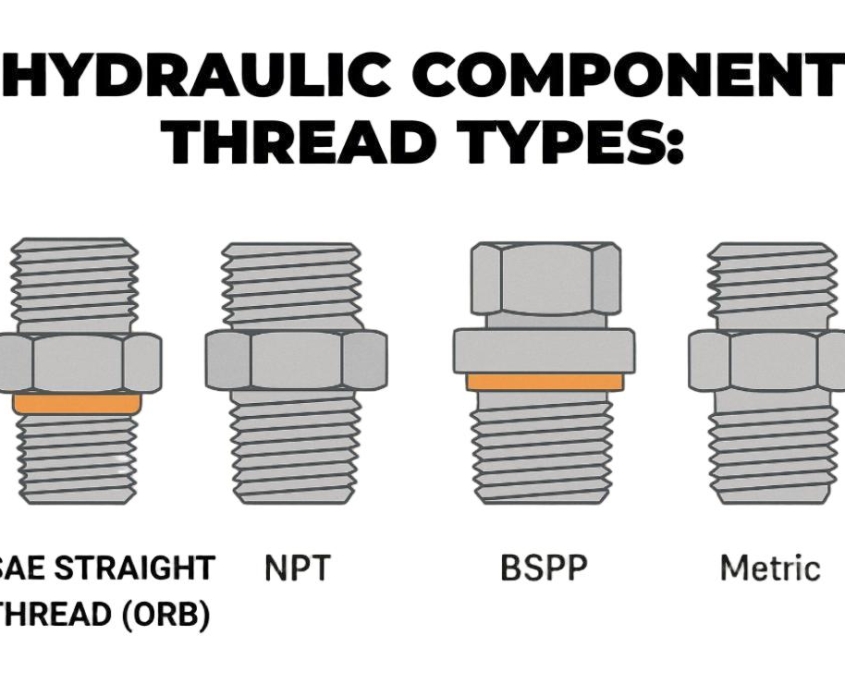
3. Understand Thread and Connection Standards
Thread type is one of the most common causes of hydraulic system failure when mismatched. Always confirm the correct standard before installation.
Hydraulic Thread Standards
| Thread Type | Region | Key Feature |
| JIC (37° flare) | North America | Metal-to-metal sealing |
| BSP / BSPT | Europe & Asia | Widely used industrial standard |
| NPT | North America | Tapered thread sealing |
| ORFS | Global | O-ring face seal, vibration resistant |
| SAE Flange (3000/6000 PSI) | Heavy-duty systems | High-pressure, large diameter |
Critical warning: Never mix thread standards. For example, an NPT fitting will damage a BSP port.
4. Check the Dash Size Carefully
Dash size is a standardized way to indicate hose and fitting dimensions based on sixteenths of an inch. Matching this correctly ensures proper flow and sealing.
Common Dash Size Conversions
| Dash Size | Inch Size | Metric Equivalent |
| -04 | 1/4″ | ~6 mm |
| -06 | 3/8″ | ~10 mm |
| -08 | 1/2″ | ~12 mm |
| -12 | 3/4″ | ~19 mm |
| -16 | 1″ | ~25 mm |
Rule of thumb: Always match dash size to the hose inner diameter to maintain correct flow and pressure performance.
5. Select the Right Material for the Environment
Hydraulic fittings must withstand not only pressure but also environmental conditions such as corrosion, moisture, and temperature changes.
Material Options
| Material | Advantages | Ideal Applications |
| Carbon Steel | Strong, cost-effective | General hydraulic systems |
| Stainless Steel | Corrosion-resistant | Marine, offshore, chemical environments |
| Brass | Good for low pressure | Water systems, light-duty applications |
Utigoflex offers multiple material options to match demanding industrial environments.
6. Never Reuse Crimped Fittings
Crimped fittings are designed for one-time use. Once removed, their structural integrity is compromised, even if they appear intact.
Why reuse is dangerous:
- Reduced pressure resistance
- Risk of leakage under vibration
- Potential hose blow-off failure
- Unpredictable performance under load
Best practice: Always install a new fitting when replacing a hose assembly.
Conclusion
Selecting the right hydraulic fitting requires attention to hose standards, fitting type, thread compatibility, size, and material. Even small mistakes can lead to leaks or system failure, so precision is essential.
Using pre-matched and tested solutions from Utigoflex helps eliminate guesswork and ensures long-term system reliability.
Why Choose Utigoflex?
Utigoflex simplifies hydraulic system safety by providing fully tested and pre-matched hose assemblies.
Key Advantages:
- Pre-crimped, ready-to-install hose systems
- Compatibility guaranteed (SAE, EN, JIC, BSP, NPT, ORFS)
- Pressure-tested for safety and reliability
- Wide range of fitting materials and sizes
- Expert technical support for selection

