
You are here: Home1 / Blog2 / Product Knowledge3 / From Rubber to Steel Wire: Understanding High-Pressure Hose Layers
From Rubber to Steel Wire: Understanding High-Pressure Hose Layers
High-pressure hoses are essential components in hydraulic systems, industrial equipment, construction machinery, and many other demanding applications. Although a hose may look like a simple flexible tube from the outside, its performance depends on several carefully engineered layers working together. Each layer has a specific role, from containing pressurized fluid to resisting abrasion, heat, chemicals, and mechanical stress.
Understanding these layers is important when selecting the right hose for a particular application. A well-designed hose must not only withstand pressure but also remain flexible, durable, and reliable throughout its service life.
The Basic Structure of a High-Pressure Hose
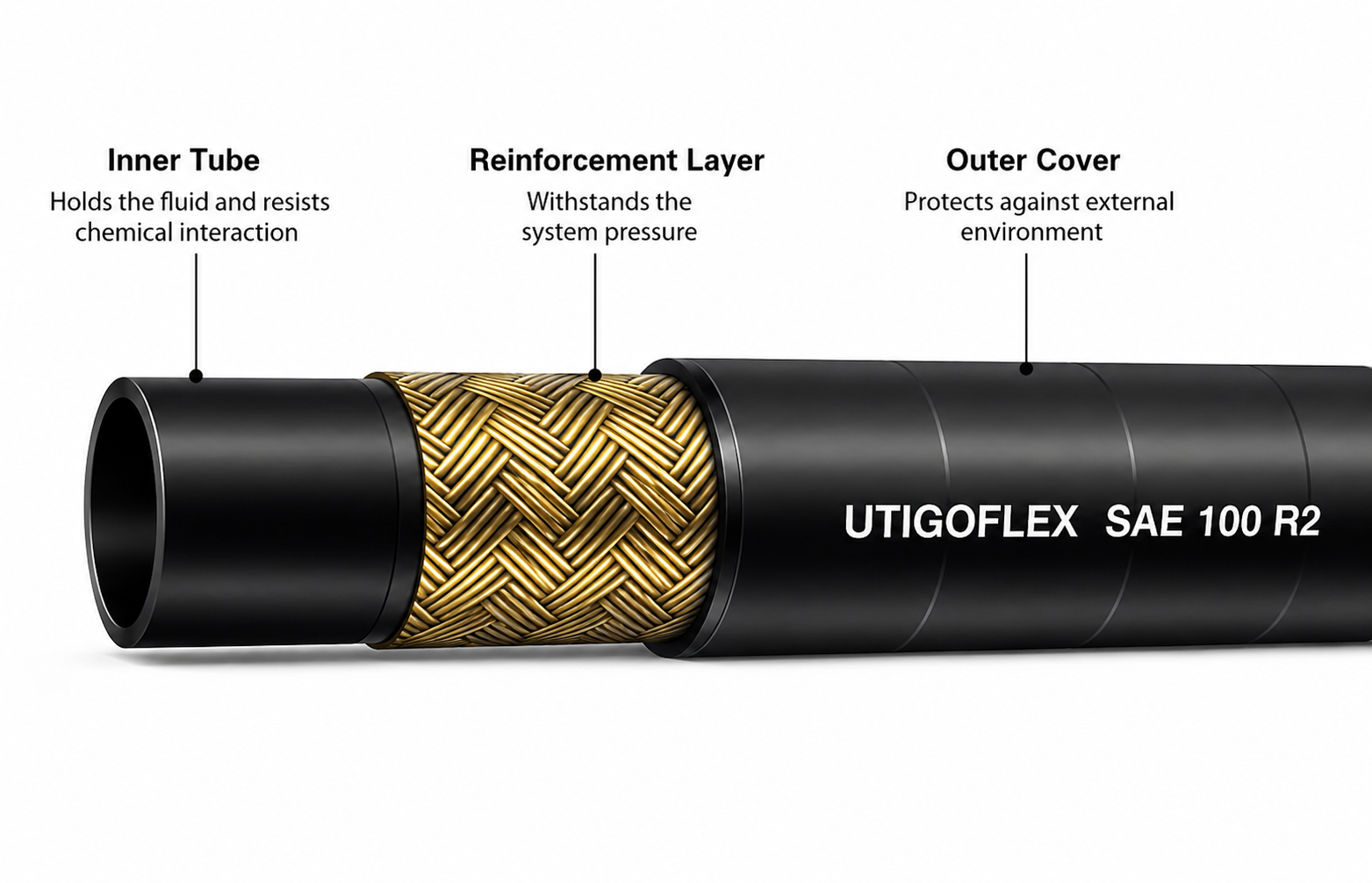
Most high-pressure hydraulic and industrial hoses consist of three primary components: the inner tube, the reinforcement layer, and the outer cover. Depending on the application, additional layers may be incorporated to improve performance.
The inner tube comes into direct contact with the fluid flowing through the hose. The reinforcement provides the strength needed to contain internal pressure, while the outer cover protects the hose from external conditions.
Together, these layers create a flexible pressure vessel capable of handling demanding operating environments.
1. The Inner Tube: The First Line of Fluid Resistance
The innermost layer is usually made from a specially formulated synthetic rubber or thermoplastic material. Its primary function is to transport hydraulic oil, water, air, chemicals, or other media without degrading.
The material must be compatible with the fluid being conveyed. For hydraulic applications, for example, the tube needs to resist the effects of hydraulic oils and additives while maintaining its flexibility and structural integrity.
Temperature is another important consideration. A hose operating in a high-temperature environment may require an inner tube formulated to withstand elevated temperatures, while hoses exposed to low temperatures need materials that remain flexible without becoming brittle.
The inner tube also influences pressure performance, flow characteristics, and resistance to permeation. Choosing the correct tube material is therefore the first step toward building a reliable high-pressure hose.
2. Reinforcement: Where the Strength Comes From
Rubber alone cannot normally withstand the extremely high pressures encountered in modern hydraulic systems. This is where reinforcement becomes critical.
The reinforcement layer is commonly made from high-strength textile fibers, braided steel wire, or spiraled steel wire. Its job is to prevent the hose from expanding excessively under pressure and to provide resistance against bursting.
For medium-pressure applications, textile or fiber reinforcement may be sufficient. As pressure requirements increase, manufacturers generally turn to steel-wire reinforcement.
Steel wire provides excellent tensile strength and pressure resistance. Depending on the hose design, the wire can be braided around the inner tube or wrapped in spiral layers. Braided reinforcement generally provides a good balance between flexibility and pressure capability, while spiral reinforcement is often used for very high-pressure applications.
This is one of the most important differences between ordinary flexible tubing and high-pressure hydraulic hose: the reinforcement transforms a flexible rubber tube into a pressure-resistant engineered assembly.
3. Multiple Steel-Wire Layers for Extreme Pressure
Some applications require hoses capable of handling exceptionally high working pressures and severe pressure impulses. In these cases, multiple layers of steel-wire reinforcement may be used.
Spiral-wire hoses can contain several alternating layers of wire arranged in carefully controlled directions. This construction helps distribute pressure forces throughout the hose wall and improves resistance to repeated pressure cycles.
High-quality manufacturing is essential here. Wire diameter, winding angle, spacing, and rubber bonding all influence the final performance of the hose. Even small variations in construction can affect pressure capability, flexibility, and fatigue resistance.
For demanding hydraulic equipment, the reinforcement must therefore be designed as part of the complete hose structure rather than treated as a simple strengthening material.
4. The Outer Cover: Protection Against the Environment
The reinforcement protects the hose from internal pressure, but it also needs protection itself. The outer cover is normally made from abrasion-resistant synthetic rubber or another suitable protective material.
During operation, hoses may rub against machinery, come into contact with dirt and moisture, or be exposed to sunlight, ozone, chemicals, and extreme temperatures. Without a durable outer cover, these environmental factors could damage the reinforcement and shorten the hose’s service life.
For equipment operating in harsh environments, manufacturers may develop specialized covers with enhanced resistance to abrasion, heat, flame, oil, or weathering.
Companies such as Utigoflex focus on hose solutions where material selection and layered construction are important to achieving dependable performance in demanding applications.
Why Every Layer Matters
A high-pressure hose should be viewed as a complete system rather than a collection of independent materials. The inner tube, reinforcement, and outer cover must work together.
For example, a hose may have exceptionally strong steel-wire reinforcement, but if the inner tube is incompatible with the working fluid, the hose can still fail prematurely. Likewise, a chemically resistant inner tube cannot compensate for an outer cover that wears rapidly in an abrasive environment.
The connection between layers is also important. Proper adhesion and manufacturing control help prevent separation between the tube, reinforcement, and cover. This is particularly important when the hose experiences repeated bending, vibration, pressure pulses, and temperature changes.
Rubber and Steel Wire: A Carefully Balanced Combination
The combination of rubber and steel wire may seem straightforward, but engineering a high-pressure hose requires careful balancing of several competing characteristics.
Increasing reinforcement can improve pressure resistance, but excessive reinforcement may reduce flexibility. A thicker outer cover can provide greater abrasion resistance, but it can also increase weight and bending stiffness. Similarly, different rubber formulations can offer better temperature or chemical resistance while affecting other properties.
Modern hose design therefore focuses on matching construction to the actual working conditions. Key factors include working pressure, maximum temperature, fluid compatibility, bend radius, pressure impulse frequency, external abrasion, and installation conditions.
Selecting the Right High-Pressure Hose
When choosing a hose, users should look beyond nominal size and pressure rating. The hose must be suitable for the complete application.
Consider the following questions:
- What fluid will flow through the hose?
- What are the normal and maximum operating pressures?
- What temperatures will the hose encounter?
- How frequently will the hose bend or flex?
- Will it be exposed to abrasion, chemicals, sunlight, or moisture?
- Is the hose subjected to pressure spikes or vibration?
- What minimum bend radius is required?
- Are there relevant industry standards or certification requirements?
Correct hose selection can improve equipment reliability, reduce maintenance requirements, and help prevent unexpected downtime.
Conclusion
From the rubber inner tube to the steel-wire reinforcement and protective outer cover, every layer of a high-pressure hose has a specific purpose. The inner tube provides fluid compatibility, the reinforcement delivers pressure resistance, and the outer cover protects the entire assembly from the surrounding environment.
Understanding this layered construction makes it easier to select hoses according to real operating requirements rather than relying solely on appearance or basic pressure specifications. As hydraulic and industrial systems continue to demand higher performance, carefully engineered hose construction remains essential for safety, durability, and reliable operation.
With the right combination of materials, reinforcement, and manufacturing quality, a flexible hose can safely handle pressures and conditions that would be impossible for rubber alone. That is the engineering principle behind the journey from rubber to steel wire—and the foundation of modern high-pressure hose technology.
Need Help Choosing the Right Industrial Hose?
[Contact Utigoflex Today] to request a specialized quote or download our complete technical assembly catalog.

