
• Facebook
  • Youtube
  • Instagram
  • WhatsApp
Give us a call now: 13510833230
Utigoflex
  • Home
  • About Us
    • Certification
  • Product
    • Hydraulic Hose
      • Braided Steel Wire Hydraulic Hose
        • SAE 100 R1 / DIN EN 853 1SN
        • SAE 100 R2 AT / DIN EN 853 2SN
        • SAE 100 R5 Steel Wire Braided Hydraulic Hose
        • SAE 100 R16 Steel Wire Braided Hydraulic Hose
        • SAE 100 R17 Steel Wire Braided Hydraulic Hose
        • EN 857 1SC Steel Wire Braided Hydraulic Hose
        • EN 857 2SC Steel Wire Braided Hydraulic Hose
      • Spiraled Steel Wire Hydraulic Hose
        • SAE 100 R9 Steel Wire Spiraled Hydraulic Hose
        • SAE 100 R12 Steel Wire Spiraled Hydraulic Hose
        • SAE 100 R13 Steel Wire Spiraled Hydraulic Hose
        • SAE 100 R15 Steel Wire Spiraled Hydraulic Hose
        • EN 856 4SH Steel Wire Spiraled Hydraulic Hose
        • EN 856 4SP Steel Wire Spiraled Hydraulic Hose
      • Thermoplastic Hydraulic Hose
        • SAE 100 R7 Thermoplastic Hydraulic Hose
        • SAE 100 R8 Thermoplastic Hydraulic Hose
        • SAE 100 R14 Stainless Steel Wire Braided with PT
      • Braided Textile Hydraulic Hose
        • SAE 100 R3
        • SAE 100 R4 Textile Braided Hydraulic Hose
        • SAE 100 R6
        • EN 854 1TE/2TE/3TE Textile Braided Hydraulic Hose
    • Rubber Hose
      • EPDM Air & Water Hose
      • Chemical Suction & Discharge Hose
      • Steam Hose
      • Fuel & Diesel Delivery Hose
      • Fuel & Diesel Suction Hose
      • LPG/CNG Rubber Hose
      • Drilling Hose
      • Air Compressor Hose
      • High pressure Washing Hose
      • Marine High Pressure Oil Conveying Hose
      • Sand Blast Rubber Hose
      • Suction & Discharge Hose
      • Concrete Delivery Hose
      • Composite Hose
      • Food Grade Hose
      • EPDM Hot Water Hose
      • Stainless Steel Flexible Hose
    • PVC Hose
      • PVC Garden Hose
      • PVC Layflat Hose
      • Multi–Purpose PVC Air Hose – Matt Surface
      • Multi–Purpose PVC Air Hose – Shining Surface
      • Smooth Surface PVC Steel Wire Hose
      • PVC Fiber Hose
      • PVC High Pressure Spray Hose
      • PVC Corrugated Suction Hose
      • PVC Grit Hose
      • PVC Kink–Proof Suction Hose
      • PVC Interlocked Hose
      • Fuel Drop Hose
    • Industrial Hose
      • ANFO Explosive Loading Hose
      • Air Hose
      • Fuel & Oil Delivery Hose
      • Chemical Hose
      • Layflat Fire Hose
      • Welding Hose
      • High Pressure Spray Hose
      • PU Suction Hose
      • PU Anti Static Suction Hose
      • PU Step Hose
      • Polypropylene Drain Hose
    • Air Duct Hose
      • PU Air Duct
      • PU Air Duct With Black Strip
      • PVC Air Duct
      • TPR (TPE) Air Duct
      • TPR (TPE) Air Duct With Green Strip
      • Silicone Coated Glass Fiber Duct
      • Portable Ventilation Duct
      • Clamped High Temperature Duct
      • Clamped Polyester Duct
      • Clamped Tarpaulin Duct
      • EPDM Fume Exhaust Hose
    • Food Grade Hose
      • Food Grade Rubber Hose
      • Smooth Surface PVC Spiral Hose
      • Smooth Surface PVC Steel Wire Hose
      • PVC Fiber Hose
    • Pneumatic Hose
      • Nylon tubing
      • PU Pneumatic Hose
    • Hydraulic Fittings
    • Hose Camlocks
    • Hose Clamps
    • Crimping/Cutting Machine
      • Crimping Machine
      • Cutting Machine
  • Services
    • Agriculture Hose Solution
    • Construction Hose Solution
    • Oil & Fuel Hose Solution
    • Chemical Industry Hose Solutions
    • Mining Hose Solution
    • Food Grade Hose Solution
  • Resources
    • Download Center
    • Blog
      • Product Knowledge
      • Company News
  • Contact Us
  • Search
  • Menu Menu
You are here: Home1 / Blog2 / Product Knowledge3 / How to Read Hydraulic Hose Markings and Technical Specifications

How to Read Hydraulic Hose Markings and Technical Specifications

Hydraulic hoses are essential components in industrial machinery, construction equipment, agricultural systems, and other hydraulic applications. However, choosing the correct hose involves more than checking its appearance or diameter. Every hydraulic hose has specific markings and technical specifications that provide important information about its performance and intended application.

For buyers, engineers, and distributors, understanding these details helps prevent incorrect selection, reduce equipment downtime, and improve system safety. This guide explains how to read hydraulic hose markings and understand the key specifications.

1. What Information Is Printed on a Hydraulic Hose?

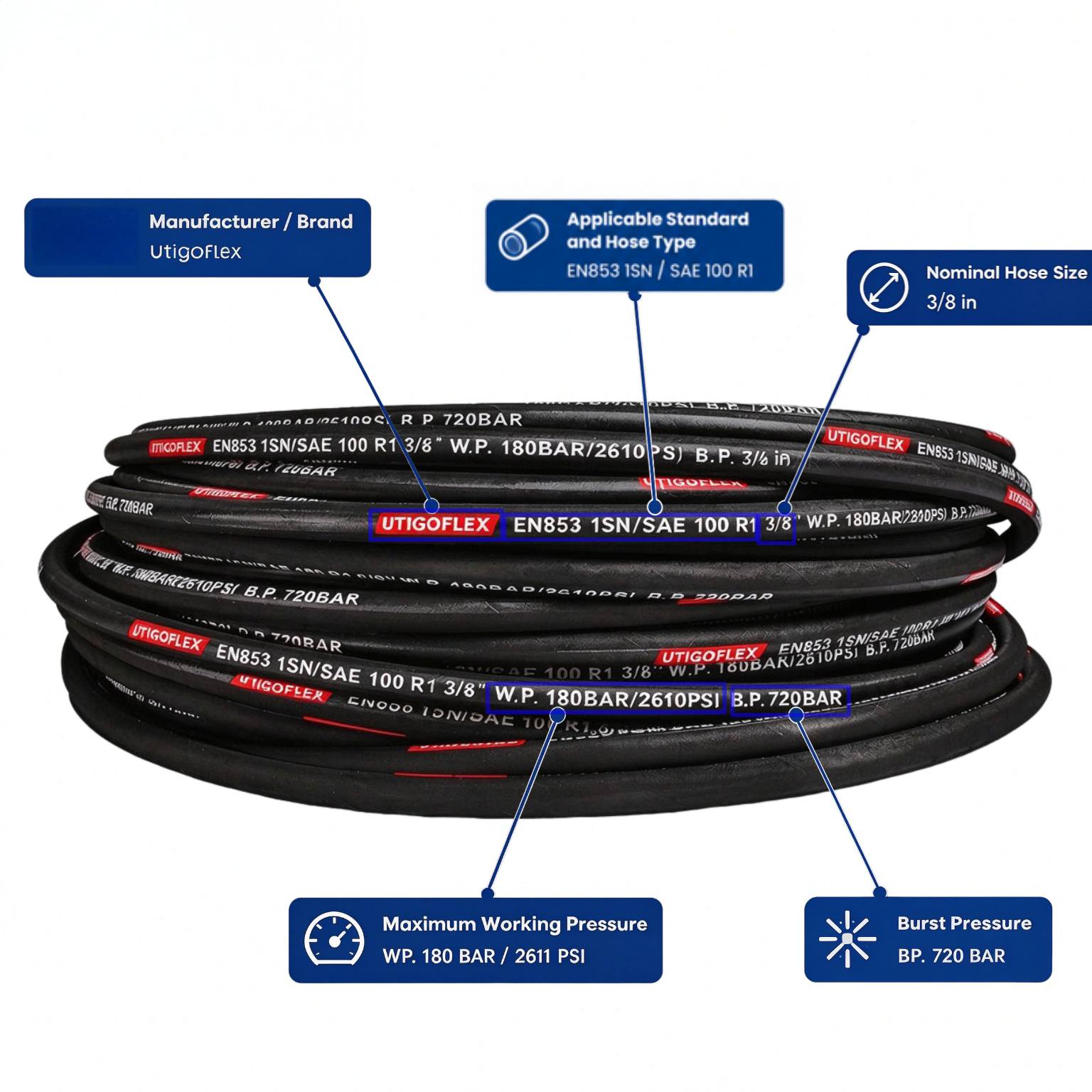
Most hydraulic hoses have a continuous printed line, commonly called a hose layline, along their outer cover. Although the exact format varies by manufacturer and standard, it typically includes several important details:

  • Manufacturer or brand name
  • Applicable hose standard and type
  • Nominal hose size
  • Maximum working pressure
  • Manufacturing date or batch identification, where applicable

For example, a hose marking might look like this:

UTIGOFLEX – SAE 100R2AT – DN12 – 27.6 MPa – 2026

This is an illustrative example, not a universal marking format. It identifies the manufacturer, hose type, nominal size, pressure rating, and production information.
2. Understand Hydraulic Hose Standards

One of the most important parts of a hose marking is its standard designation. Common standards include SAE and EN specifications.

Examples include:

  • SAE 100R1AT:A hydraulic hose with one layer of steel wire braid.
  • SAE 100R2AT:A hydraulic hose with two layers of steel wire braid.
  • SAE 100R16:A compact, high-pressure hydraulic hose with two layers of steel wire braid.
  • EN 853 1SN:A hose with one layer of steel wire braid.
  • EN 853 2SN:A hose with two layers of steel wire braid.

These designations indicate the hose construction and applicable performance requirements. However, hoses with similar reinforcement structures are not automatically interchangeable. Their pressure ratings, dimensions, temperature limits, and other requirements must also be checked.

When purchasing hydraulic hoses, always confirm that the specified standard matches the equipment manufacturer’s requirements.

3. How to Read Hydraulic Hose Size

Hydraulic hose size is generally identified by its nominal inside diameter (ID).

Two common sizing systems are used:

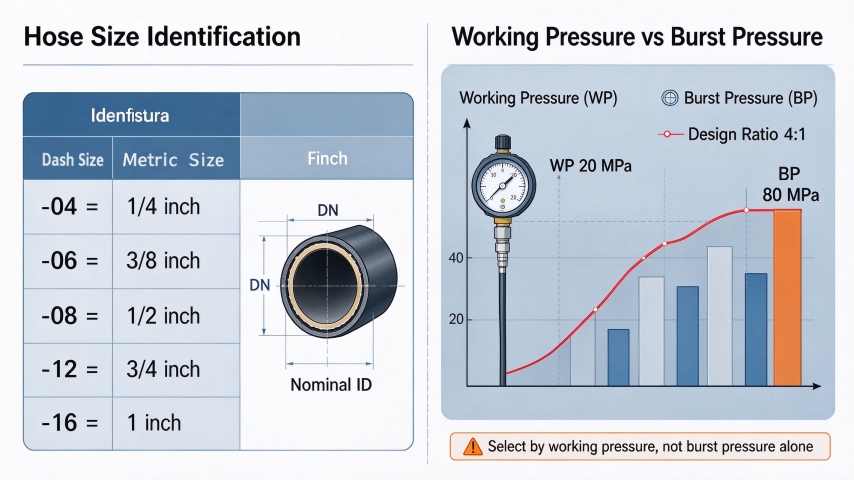
Dash Size (-XX): A standardized identification system in which the number generally represents the nominal inside diameter in sixteenths of an inch.

For example:

  • -04 = 1/4 inch
  • -06 = 3/8 inch
  • -08 = 1/2 inch
  • -12 = 3/4 inch
  • -16 = 1 inch

Metric Size (DN): This system expresses the nominal inside diameter in millimeters. For example, DN12 generally refers to a nominal 12 mm inside diameter.

Choosing the correct size is important because an undersized hose can increase fluid velocity and pressure loss, while an oversized hose may increase system costs and installation space requirements.

4. Understand Working Pressure and Burst Pressure

Pressure ratings are among the most important hydraulic hose specifications.

Working Pressure (WP) refers to the maximum pressure at which a hose is designed to operate continuously under its specified conditions.

Burst Pressure (BP) refers to the pressure at which a hose fails during a burst test. It is not an allowable operating pressure.

Many hydraulic hose designs use a burst-to-working-pressure ratio of 4:1, but this depends on the applicable standard and product specification.

For example, if a hose has a working pressure of 20 MPa and a specified 4:1 design ratio, its corresponding minimum burst pressure would be 80 MPa.

Never select a hose based on burst pressure alone. The system’s maximum operating pressure, including pressure surges, must remain within the hose assembly’s permitted limits.
5. Check Temperature and Fluid Compatibility

Pressure is not the only factor affecting hose performance. Temperature and fluid compatibility are equally important.

Temperature Rating: Hydraulic hoses have specified operating temperature ranges. Excessive heat can accelerate rubber aging, while very low temperatures may reduce flexibility and increase the risk of cracking.

Fluid Compatibility: The inner tube material must be compatible with the hydraulic fluid being transported. Different rubber compounds may have different resistance to mineral oils, synthetic fluids, water-based fluids, and other media.

For example, an NBR inner tube is commonly used for petroleum-based hydraulic oils, but the exact suitability depends on the fluid composition and operating conditions.

Always check the manufacturer’s compatibility recommendations before selecting a hose.

6. Don’t Ignore Minimum Bend Radius and Other Specifications

Several additional specifications affect hose installation and service life:

  • Minimum Bend Radius:The smallest radius at which a hose can bend without compromising its performance.
  • Reinforcement Type:Indicates whether the hose uses textile reinforcement, steel wire braid, or steel wire spiral construction.
  • Outer Diameter (OD):Important for fitting compatibility, clamps, and installation space.
  • Electrical Properties:Certain applications require electrically conductive or non-conductive hoses.

For buyers working with different hydraulic hose models, Utigoflex recommends checking these parameters alongside pressure and size to ensure the hose matches the actual operating environment.

7. How to Choose the Right Hydraulic Hose

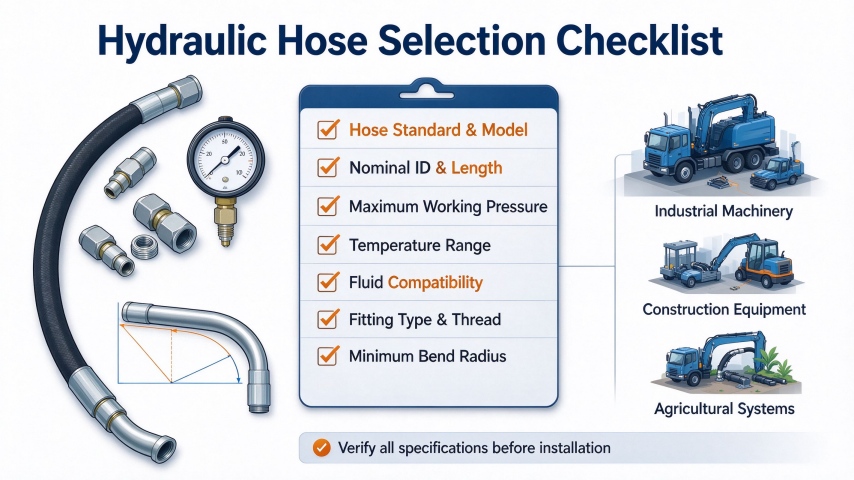
Before placing an order, buyers should confirm the following information:

  1. Required hose standard and model.
  2. Nominal inside diameter and overall length.
  3. Maximum working pressure.
  4. Operating temperature range.
  5. Hydraulic fluid compatibility.
  6. Fitting type, thread size, and connection configuration.
  7. Minimum bend radius and installation requirements.

A reliable supplier should be able to provide detailed technical data and help verify whether the selected hose meets the application requirements.

At Utigoflex, understanding product specifications is an important part of helping customers select suitable hydraulic hose solutions for different industrial applications.
FAQ

Q1: Where can I find hydraulic hose specifications?

Most basic information is printed on the hose cover. Detailed specifications can be found in the manufacturer’s technical datasheet.

Q2: Does a larger hydraulic hose size mean higher pressure?

No. Hose diameter and pressure rating are different specifications. Pressure capacity depends on hose construction, materials, reinforcement, and design.

Q3: Can I replace a hydraulic hose with one that has the same diameter?

Not necessarily. You must also verify the pressure rating, hose standard, temperature range, fluid compatibility, fittings, and installation requirements.

Conclusion

Reading hydraulic hose markings is an essential skill for anyone involved in hydraulic system design, purchasing, or maintenance. By understanding the hose standard, size, working pressure, temperature rating, and other technical specifications, buyers can make more informed decisions and reduce the risk of incorrect hose selection.

Build Your Safe Systems with Utigoflex

Utigoflex provides a range of hydraulic hose products to meet different industrial requirements. Contact our team to discuss your specifications and find a suitable hose solution for your application.

[Contact Utigoflex Today] to request a specialized quote or download our complete technical assembly catalog.

byadministratorSkila/October 26, 2026/inBlog, Product Knowledge
Recent
  • PVC vs. Rubber Food-Grade Hoses: Key Differences and Ap...November 17, 2026 - 7:18 am
  • How to Identify Hydraulic Hose Fitting Threads: A Complete...November 13, 2026 - 6:55 am
  • What Are Rubber Hoses Used For?November 10, 2026 - 7:48 am
  • Mining Hose Requirements: Pressure, Abrasion & Saf...November 5, 2026 - 9:31 am
  • How to Size Industrial Hoses: Flow Rate & Diameter...October 30, 2026 - 2:04 am
  • How to Read Hydraulic Hose Markings and Technical Speci...October 26, 2026 - 7:15 am
  • What Is a PVC Fibre Reinforced Suction Hose?October 23, 2026 - 8:21 am
  • Multi-Purpose PVC Air Hose: Applications and FeaturesOctober 20, 2026 - 10:02 am
Popular
  • Engineering PlasticsApril 18, 2024 - 9:54 am
  • Factory informationApril 18, 2024 - 9:58 am
  • Hydraulic hose workshopApril 18, 2024 - 10:00 am
  • Hydraulic hosesApril 18, 2024 - 10:01 am
  • Packaging & WarehouseApril 18, 2024 - 10:01 am
  • Production lineApril 18, 2024 - 10:02 am
  • EPDM vs Silicone Hose: Which Is Better for High Tempera...September 30, 2026 - 8:37 am
  • Carbon Steel vs Stainless Steel Hose Fittings: Which Is...September 21, 2026 - 8:40 am
Comments
  • Awaiting check payment Order status changed from Pending...December 19, 2022 - 2:54 am by WooCommerce
  • Awaiting check payment Order status changed from Pending...December 12, 2022 - 2:14 pm by WooCommerce
  • Awaiting check payment Order status changed from Pending...December 12, 2022 - 1:37 pm by WooCommerce
  • Order cancelled by customer. Order status changed from Pending...November 16, 2022 - 11:59 am by WooCommerce
  • Awaiting check payment Order status changed from Pending...October 30, 2022 - 7:20 am by WooCommerce
  • Unpaid order cancelled - time limit reached. Order status...October 14, 2022 - 8:46 am by WooCommerce
  • Unpaid order cancelled - time limit reached. Order status...September 6, 2022 - 7:40 pm by WooCommerce
  • Awaiting check payment Order status changed from Pending...September 6, 2022 - 5:49 pm by WooCommerce
Tags

Categories

  • Blog
  • Company News
  • Product Knowledge
  • Uncategorized
  • Facebook
  • X
  • LinkedIn
  • Youtube
  • Instagram
  • steven@utigoflexhose.com
  • FACEBOOK
  • Instagram
  • YOUTUBE
  • 13510833230

Company

    • About Us
    • Products
    • Resources
    • Contact Us

Product

  • Hydraulic Hose
  • Rubber Hose
  • PVC Hose
  • Industrial Hose
  • Air Duct Hose
  • Food Grade Hose
  • Pneumatic Hose

Technical Support

    • Plastic Hoses Catalogue
    • Rubber Hose Catalogue
    • Hydraulic Fittings Catalogue
    • Privacy Policy

Follow Us

Copyright @ Utigoflex | All rights reserved
What Is a PVC Fibre Reinforced Suction Hose?How to Size Industrial Hoses: Flow Rate & Diameter Guide
Scroll to top

This site uses cookies. By continuing to browse the site, you are agreeing to our use of cookies.

Agree & ContinueSettingsReject

Cookie and Privacy Settings


How we use cookies

We may request cookies to be set on your device. We use cookies to let us know when you visit our websites, how you interact with us, to enrich your user experience, and to customize your relationship with our website.

Click on the different category headings to find out more. You can also change some of your preferences. Note that blocking some types of cookies may impact your experience on our websites and the services we are able to offer.

Essential Website Cookies

These cookies are strictly necessary to provide you with services available through our website and to use some of its features.

Because these cookies are strictly necessary to deliver the website, refusing them will have impact how our site functions. You always can block or delete cookies by changing your browser settings and force blocking all cookies on this website. But this will always prompt you to accept/refuse cookies when revisiting our site.

We fully respect if you want to refuse cookies but to avoid asking you again and again kindly allow us to store a cookie for that. You are free to opt out any time or opt in for other cookies to get a better experience. If you refuse cookies we will remove all set cookies in our domain.

We provide you with a list of stored cookies on your computer in our domain so you can check what we stored. Due to security reasons we are not able to show or modify cookies from other domains. You can check these in your browser security settings.

Google Analytics Cookies

These cookies collect information that is used either in aggregate form to help us understand how our website is being used or how effective our marketing campaigns are, or to help us customize our website and application for you in order to enhance your experience.

If you do not want that we track your visit to our site you can disable tracking in your browser here:

Other external services

We also use different external services like Google Webfonts, Google Maps, and external Video providers. Since these providers may collect personal data like your IP address we allow you to block them here. Please be aware that this might heavily reduce the functionality and appearance of our site. Changes will take effect once you reload the page.

Google Webfont Settings:

Google Map Settings:

Google reCaptcha Settings:

Vimeo and Youtube video embeds:

Other cookies

The following cookies are also needed - You can choose if you want to allow them:

Privacy Policy

You can read about our cookies and privacy settings in detail on our Privacy Policy Page.

Privacy Policy
Accept settingsHide notification only
Skip to content
Open toolbar Accessibility Tools

Accessibility Tools

  • Increase TextIncrease Text
  • Decrease TextDecrease Text
  • GrayscaleGrayscale
  • High ContrastHigh Contrast
  • Negative ContrastNegative Contrast
  • Light BackgroundLight Background
  • Links UnderlineLinks Underline
  • Readable FontReadable Font
  • Reset Reset