
• Facebook
  • Youtube
  • Instagram
  • WhatsApp
Give us a call now: 13510833230
Utigoflex
  • Home
  • About Us
    • Certification
  • Product
    • Hydraulic Hose
      • Braided Steel Wire Hydraulic Hose
        • SAE 100 R1 / DIN EN 853 1SN
        • SAE 100 R2 AT / DIN EN 853 2SN
        • SAE 100 R5 Steel Wire Braided Hydraulic Hose
        • SAE 100 R16 Steel Wire Braided Hydraulic Hose
        • SAE 100 R17 Steel Wire Braided Hydraulic Hose
        • EN 857 1SC Steel Wire Braided Hydraulic Hose
        • EN 857 2SC Steel Wire Braided Hydraulic Hose
      • Spiraled Steel Wire Hydraulic Hose
        • SAE 100 R9 Steel Wire Spiraled Hydraulic Hose
        • SAE 100 R12 Steel Wire Spiraled Hydraulic Hose
        • SAE 100 R13 Steel Wire Spiraled Hydraulic Hose
        • SAE 100 R15 Steel Wire Spiraled Hydraulic Hose
        • EN 856 4SH Steel Wire Spiraled Hydraulic Hose
        • EN 856 4SP Steel Wire Spiraled Hydraulic Hose
      • Thermoplastic Hydraulic Hose
        • SAE 100 R7 Thermoplastic Hydraulic Hose
        • SAE 100 R8 Thermoplastic Hydraulic Hose
        • SAE 100 R14 Stainless Steel Wire Braided with PT
      • Braided Textile Hydraulic Hose
        • SAE 100 R3
        • SAE 100 R4 Textile Braided Hydraulic Hose
        • SAE 100 R6
        • EN 854 1TE/2TE/3TE Textile Braided Hydraulic Hose
    • Rubber Hose
      • EPDM Air & Water Hose
      • Chemical Suction & Discharge Hose
      • Steam Hose
      • Fuel & Diesel Delivery Hose
      • Fuel & Diesel Suction Hose
      • LPG/CNG Rubber Hose
      • Drilling Hose
      • Air Compressor Hose
      • High pressure Washing Hose
      • Marine High Pressure Oil Conveying Hose
      • Sand Blast Rubber Hose
      • Suction & Discharge Hose
      • Concrete Delivery Hose
      • Composite Hose
      • Food Grade Hose
      • EPDM Hot Water Hose
      • Stainless Steel Flexible Hose
    • PVC Hose
      • PVC Garden Hose
      • PVC Layflat Hose
      • Multi–Purpose PVC Air Hose – Matt Surface
      • Multi–Purpose PVC Air Hose – Shining Surface
      • Smooth Surface PVC Steel Wire Hose
      • PVC Fiber Hose
      • PVC High Pressure Spray Hose
      • PVC Corrugated Suction Hose
      • PVC Grit Hose
      • PVC Kink–Proof Suction Hose
      • PVC Interlocked Hose
      • Fuel Drop Hose
    • Industrial Hose
      • ANFO Explosive Loading Hose
      • Air Hose
      • Fuel & Oil Delivery Hose
      • Chemical Hose
      • Layflat Fire Hose
      • Welding Hose
      • High Pressure Spray Hose
      • PU Suction Hose
      • PU Anti Static Suction Hose
      • PU Step Hose
      • Polypropylene Drain Hose
    • Air Duct Hose
      • PU Air Duct
      • PU Air Duct With Black Strip
      • PVC Air Duct
      • TPR (TPE) Air Duct
      • TPR (TPE) Air Duct With Green Strip
      • Silicone Coated Glass Fiber Duct
      • Portable Ventilation Duct
      • Clamped High Temperature Duct
      • Clamped Polyester Duct
      • Clamped Tarpaulin Duct
      • EPDM Fume Exhaust Hose
    • Food Grade Hose
      • Food Grade Rubber Hose
      • Smooth Surface PVC Spiral Hose
      • Smooth Surface PVC Steel Wire Hose
      • PVC Fiber Hose
    • Pneumatic Hose
      • Nylon tubing
      • PU Pneumatic Hose
    • Hydraulic Fittings
    • Hose Camlocks
    • Hose Clamps
    • Crimping/Cutting Machine
      • Crimping Machine
      • Cutting Machine
    • Rubber Sheet
  • Services
    • Agriculture Hose Solution
    • Construction Hose Solution
    • Oil & Fuel Hose Solution
    • Chemical Industry Hose Solutions
    • Mining Hose Solution
    • Food Grade Hose Solution
  • Resources
    • Download Center
    • Technical Guides
    • Blog
      • Product Knowledge
      • Company News
  • Contact Us
  • Search
  • Menu Menu
You are here: Home1 / Resource2 / Technical Guidance3 / Silicone Hoses vs. Rubber Hoses: Which One Is Right for You?

Silicone Hoses vs. Rubber Hoses: Which One Is Right for You?

When selecting hoses for your industrial applications, you often face the dilemma of choosing between silicone and rubber hoses. While the performance characteristics of these two materials differ significantly, this does not mean their uses and application scenarios are similar. Choosing the wrong material can lead to cracking, leaks, or even catastrophic production accidents.
Therefore, this article provides a detailed analysis of the key differences, pros and cons, and optimal application scenarios for silicone and rubber hoses.
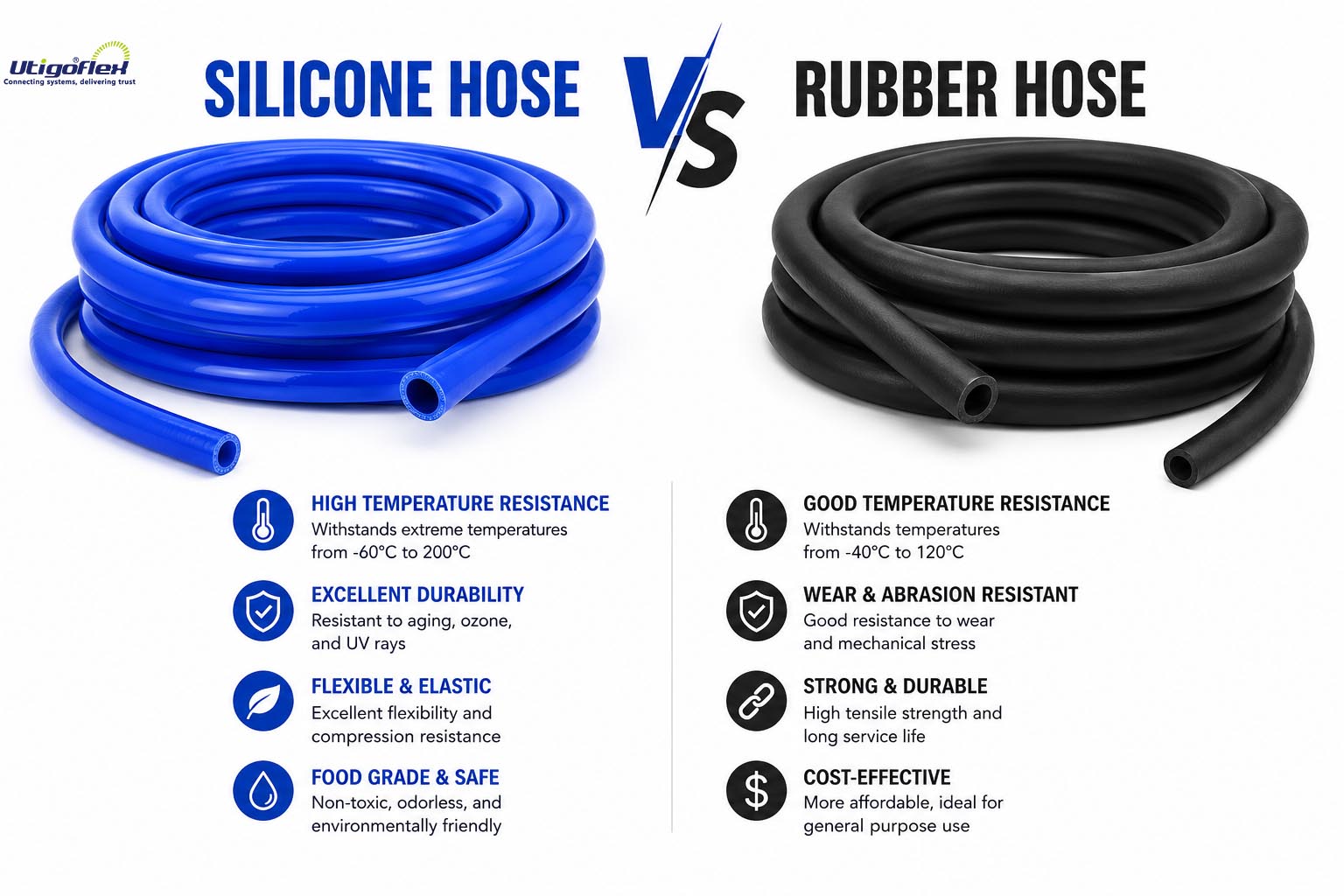
Silicone Hoses vs. Rubber Hoses

1. What are Rubber Hoses Made of?

Traditional rubber hoses are made from thermoset elastomers like EPDM (ethylene propylene diene monomer) or nitrile rubber. They’re reinforced with polyester or fabric cords for burst strength.

2. What are Silicone Hoses Made of?

Silicone is a synthetic elastomer containing silicon, oxygen, and other elements. High-quality silicone hoses include multiple layers of reinforced fabric (polyester, fiberglass, or aramid) to handle pressure.
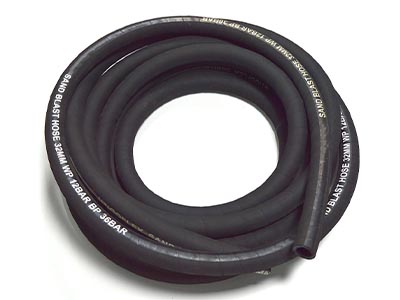
Sand Blast Rubber Hose

3. The Difference Between Rubber Hoses and Silicone Hoses

What are Rubber Hoses Made of?

Traditional rubber hoses are made from thermosetting elastomers, such as ethylene propylene diene monomer (EPDM) or nitrile rubber. To enhance burst resistance, these hoses are typically reinforced with polyester fibers or fabric cords.
As a result, rubber hoses offer superior oil resistance, durability, and corrosion resistance, and are particularly effective at withstanding pressure and vibration.

What are Silicone Hoses Made of?

Silicone is a synthetic elastomer containing silicon, oxygen, and other elements. High-quality silicone hoses incorporate multiple layers of reinforcing fabric (polyester, glass fiber, or aramid) to withstand pressure.
Consequently, silicone hoses can withstand a wider temperature range than rubber hoses, offer superior flexibility, and resist a broader range of corrosive media. Additionally, silicone hoses provide excellent electrical insulation. Furthermore, silicone hoses are typically non-toxic and odorless, making them commonly used in food and medical applications.
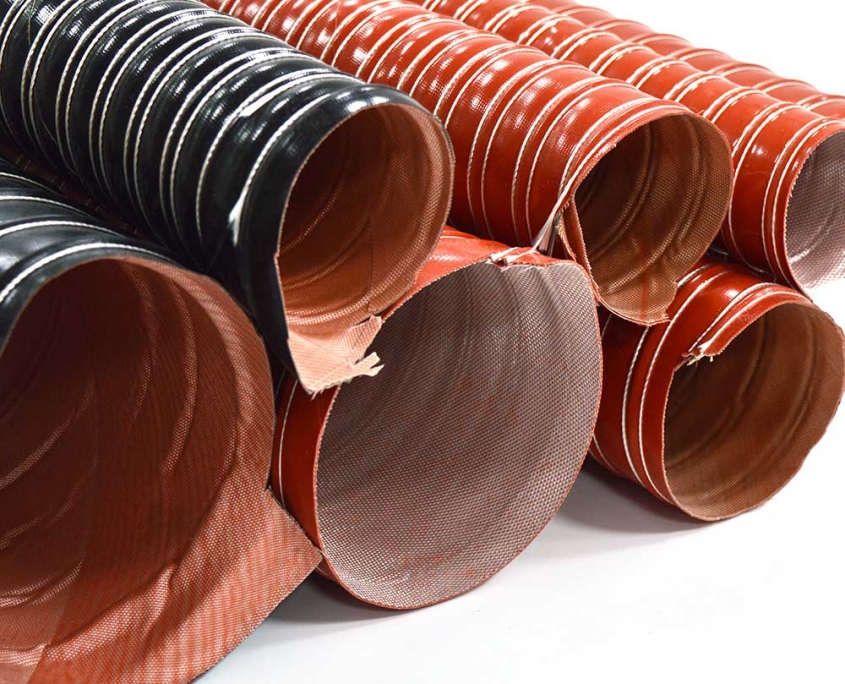
Silicone Coated Glass Fiber Duct

4. Rubber Hose vs. Silicone Hose: Pros and Cons

Advantages of Rubber Hoses:

Affordable – Stock replacement hoses are cheap and widely available.

Excellent oil and fuel resistance (Nitrile/Neoprene) – Perfect for fuel lines or crankcase ventilation.

High abrasion resistance – Stands up to rubbing against engine components.

High burst strength – OEM-grade rubber hoses are very tough.

Advantages of Silicone Hoses:

Extreme temperature tolerance – Handles both engine bay heat and freezing cold without hardening or melting.

Long service life – Resists aging, UV, and ozone. Won’t crack like old rubber.

Flexible and easy to install – Stays pliable for years, making routing easier.

Smooth internal bore – Minimal flow restriction for coolant or air.

Looks great – Available in many colors for custom engine bays.

Disadvantages of Rubber Hoses:

Heat degrades them – Over 250°F (121°C), rubber hardens, cracks, and fails.

Short lifespan – Ozone and UV attack rubber; expect to replace every 4–8 years.

Gets stiff in cold – Hard to remove or install when frozen.

Disadvantages of Silicone Hoses:

Expensive – Can cost 3–5 times more than rubber.

Poor oil/fuel resistance – Standard silicone swells and fails when exposed to petroleum.

Lower tear strength – Easier to nick or puncture than rubber.

Permeability – Slightly more water vapor permeation than EPDM.

5. Comparison Table: Rubber Hose vs. Silicone Hose

Feature Rubber Hose Silicone Hose
Cost Affordable: Low cost and widely available as OEM replacements. Expensive: Can cost 3 to 5 times more than rubber.
Temperature Resistance Limited: Hardens and cracks above 121°C (250°F); stiffens in cold. Extreme: Excellent tolerance for high engine heat and freezing cold.
Lifespan Shorter: Lasts 4–8 years; prone to ozone and UV degradation. Long-lasting: Resists aging and UV; will not crack over time.
Oil & Fuel Resistance Excellent: (e.g., Nitrile/Neoprene) Ideal for fuel lines and crankcase ventilation. Poor: Standard silicone swells and fails when exposed to oil or fuel.
Durability High Abrasion Resistance: Stands up well to rubbing and high burst pressure. Lower Tear Strength: Easier to nick or puncture compared to rubber.
Flexibility Variable: Becomes stiff and difficult to install in cold temperatures. High: Stays pliable for years, making routing and installation easier.
Flow Efficiency Standard internal surface. Smooth Bore: Minimal flow restriction for coolant or air.
Permeability Low: Better at containing water vapor. Higher: Slightly more water vapor permeation than EPDM rubber.
Aesthetics Basic (usually black). Customizable: Available in many colors for a custom look.

6. Quick Summary

  • Choose Rubber if: You are on a budget, need a direct factory replacement, or the hose will be in constant contact with fuel or oil.

  • Choose Silicone if: You want a “set and forget” solution for coolant or air intake, operate in extreme temperature environments, or want to improve the look of your engine bay.

7. Understanding Their Applications:

Applications of Silicone Hoses:

  • You have a turbocharged or race car – Engine bay temps often exceed 250°F.
  • You want a “fit and forget” solution – Silicone lasts over a decade.
  • You need a tight bend radius – Silicone handles tighter curves without kinking.
  • You live in extreme climates – Cold starts in Alaska or desert heat in Arizona.
  • You have a marine or outdoor application – UV and salt air destroy rubber quickly.

Applications of Rubber Hoses:

  • You’re on a budget – A rubber radiator hose might cost 15vs.15vs.80 for silicone.
  • The hose carries oil or fuel – Standard silicone will fail. Use rubber or special fluorosilicone.
  • The hose will see physical abrasion – Rubbing against brackets or frame rails.
  • You need an immediate replacement – Every auto parts store stocks rubber hoses.
  • Industrial hydraulic or pneumatic use – Rubber handles higher pressures better.

8. Application Guide: When to Use Silicone vs. Rubber

Application Scenario Best Choice Why?
High-Performance / Racing Silicone Engine bay temperatures often exceed 250°F (121°C), which causes rubber to fail quickly.
Fuel & Oil Lines Rubber Standard silicone swells and degrades when exposed to petroleum. Rubber (Nitrile/Neoprene) is specifically designed for this.
Long-Term Reliability Silicone A “fit and forget” solution that lasts over a decade without cracking or aging.
Budget-Conscious Repair Rubber Significant cost savings; a rubber radiator hose may cost $15 compared to $80 for silicone.
Extreme Climates Silicone Handles both Alaskan cold starts and Arizona desert heat without losing flexibility or melting.
High Physical Abrasion Rubber Superior resistance to rubbing against engine brackets, frame rails, or sharp edges.
Marine & Outdoor Use Silicone Highly resistant to UV rays and salty air, which rapidly destroy standard rubber.
Immediate Replacement Rubber Readily available in stock at almost every local auto parts store.
Tight Routing Silicone Can handle tighter bend radii without kinking compared to stiff rubber.
Industrial Hydraulics Rubber Better suited for the extremely high pressures found in hydraulic or pneumatic systems.

9. Summary Recommendations

  • Go with Silicone for: Turbocharged builds, custom engine bays, show cars, and cooling systems where you want maximum longevity.
  • Go with Rubber for: Fuel lines, oil breathers, daily drivers on a budget, and any situation where the hose is likely to rub against other metal components.
Chemicals

10. Frequently Asked Questions:

  • Myth 1: Silicone hoses last forever.
    Reality: They last much longer than rubber, but clamps can loosen as silicone relaxes over time. Check tension yearly.
  • Myth 2: Rubber hoses are all the same.
    Reality: EPDM (coolant), nitrile (fuel), neoprene (oil), and natural rubber (low pressure) are very different. Use the right type.
  • Myth 3: You can use silicone coolant hoses with any clamp.
    Reality: Silicone is softer. Spring clamps or constant-tension clamps work best. Standard worm-drive clamps can cut into the hose as it compresses.

11. Conclusion

You can quickly determine whether to choose a silicone hose or a rubber hose in three steps:

  • Consider the conveyed medium: If the medium contains oil, fuel, or organic solvents, you must choose a rubber hose (either nitrile or fluorocarbon rubber); silicone hoses tend to swell and fail when exposed to oil.
  • Consider the application standards: For non-oily media, if food-grade or medical-grade certification is required, choose a silicone hose directly;
  • Consider the operating temperature: If no certification is required, consider the temperature. For operating conditions above 120°C or below -30°C, choose a silicone hose; for temperatures within the  -30°C to 120°C range, both are suitable, but prioritize rubber hoses for their better cost-effectiveness.

If you are unsure which type of hose is best for your system, consulting an experienced supplier or technical specialist can help ensure the safest and most effective solution. Contact Us Now.

byadministratorKathy/May 14, 2026/inTechnical Guidance

Recent
  • Silicone Hoses vs. Rubber HosesSilicone Hoses vs. Rubber Hoses: Which One Is Right for...May 14, 2026 - 7:32 am
  • Industrial Hose Bend RadiusIndustrial Hose Bend Radius: Key Guide, Mistakes to Avoid...May 8, 2026 - 9:58 am
  • What is the Difference Between Conductive and Non-Conductive HosesWhat is the Difference Between Conductive and Non-Conductive...May 7, 2026 - 9:43 am
  • Which Hose Material is Best for High Temperature and High PressureWhich Hose Material is Best for High Temperature and High...April 30, 2026 - 7:35 am
  • How Should Hydraulic Hoses Be Stored ProperlyHow Should Hydraulic Hoses Be Stored Properly?April 29, 2026 - 7:36 am
  • How to Choose the Right Hose Clamp for Your IndustryHow to Choose the Right Hose Clamp for Your IndustryApril 24, 2026 - 7:13 am
  • PVC Air Duct Hose vs PU Air Duct HosePVC vs. PU Duct Hose: Which One Is Right for Your Appli...April 22, 2026 - 8:49 am
  • What is an Air Duct HoseWhat is an Air Duct Hose? A Complete Guide to Flexible ...April 21, 2026 - 8:00 am
Popular
  • Engineering PlasticsApril 18, 2024 - 9:54 am
  • Factory informationApril 18, 2024 - 9:58 am
  • Hydraulic hose workshopApril 18, 2024 - 10:00 am
  • Hydraulic hosesApril 18, 2024 - 10:01 am
  • Packaging & WarehouseApril 18, 2024 - 10:01 am
  • Production lineApril 18, 2024 - 10:02 am
  • Layflat Discharge Hoses: The Future of Lightweight Fluid...October 24, 2025 - 9:43 am
  • How to Choose the Right Industrial Hose for Your Applic...March 20, 2025 - 2:18 am
Comments
  • Awaiting check payment Order status changed from Pending...December 19, 2022 - 2:54 am by WooCommerce
  • Awaiting check payment Order status changed from Pending...December 12, 2022 - 2:14 pm by WooCommerce
  • Awaiting check payment Order status changed from Pending...December 12, 2022 - 1:37 pm by WooCommerce
  • Order cancelled by customer. Order status changed from Pending...November 16, 2022 - 11:59 am by WooCommerce
  • Awaiting check payment Order status changed from Pending...October 30, 2022 - 7:20 am by WooCommerce
  • Unpaid order cancelled - time limit reached. Order status...October 14, 2022 - 8:46 am by WooCommerce
  • Unpaid order cancelled - time limit reached. Order status...September 6, 2022 - 7:40 pm by WooCommerce
  • Awaiting check payment Order status changed from Pending...September 6, 2022 - 5:49 pm by WooCommerce
Tags

Categories

  • Blog
  • Company News
  • Product Knowledge
  • Technical Guidance
  • Uncategorized
  • Facebook
  • X
  • LinkedIn
  • Youtube
  • Instagram
  • steven@utigoflexhose.com
  • FACEBOOK
  • Instagram
  • YOUTUBE
  • 13510833230

Company

    • About Us
    • Products
    • Resources
    • Contact Us

Product

  • Hydraulic Hose
  • Rubber Hose
  • PVC Hose
  • Industrial Hose
  • Air Duct Hose
  • Food Grade Hose
  • Pneumatic Hose

Technical Support

    • Plastic Hoses Catalogue
    • Rubber Hose Catalogue
    • Hydraulic Fittings Catalogue
    • Privacy Policy

Follow Us

Copyright @ Utigoflex | All rights reserved
Industrial Hose Bend Radius: Key Guide, Mistakes to Avoid & Selection ...Industrial Hose Bend Radius
Scroll to top

This site uses cookies. By continuing to browse the site, you are agreeing to our use of cookies.

Agree & ContinueSettingsReject

Cookie and Privacy Settings


How we use cookies

We may request cookies to be set on your device. We use cookies to let us know when you visit our websites, how you interact with us, to enrich your user experience, and to customize your relationship with our website.

Click on the different category headings to find out more. You can also change some of your preferences. Note that blocking some types of cookies may impact your experience on our websites and the services we are able to offer.

Essential Website Cookies

These cookies are strictly necessary to provide you with services available through our website and to use some of its features.

Because these cookies are strictly necessary to deliver the website, refusing them will have impact how our site functions. You always can block or delete cookies by changing your browser settings and force blocking all cookies on this website. But this will always prompt you to accept/refuse cookies when revisiting our site.

We fully respect if you want to refuse cookies but to avoid asking you again and again kindly allow us to store a cookie for that. You are free to opt out any time or opt in for other cookies to get a better experience. If you refuse cookies we will remove all set cookies in our domain.

We provide you with a list of stored cookies on your computer in our domain so you can check what we stored. Due to security reasons we are not able to show or modify cookies from other domains. You can check these in your browser security settings.

Google Analytics Cookies

These cookies collect information that is used either in aggregate form to help us understand how our website is being used or how effective our marketing campaigns are, or to help us customize our website and application for you in order to enhance your experience.

If you do not want that we track your visit to our site you can disable tracking in your browser here:

Other external services

We also use different external services like Google Webfonts, Google Maps, and external Video providers. Since these providers may collect personal data like your IP address we allow you to block them here. Please be aware that this might heavily reduce the functionality and appearance of our site. Changes will take effect once you reload the page.

Google Webfont Settings:

Google Map Settings:

Google reCaptcha Settings:

Vimeo and Youtube video embeds:

Other cookies

The following cookies are also needed - You can choose if you want to allow them:

Privacy Policy

You can read about our cookies and privacy settings in detail on our Privacy Policy Page.

Privacy Policy
Accept settingsHide notification only
Skip to content
Open toolbar Accessibility Tools

Accessibility Tools

  • Increase TextIncrease Text
  • Decrease TextDecrease Text
  • GrayscaleGrayscale
  • High ContrastHigh Contrast
  • Negative ContrastNegative Contrast
  • Light BackgroundLight Background
  • Links UnderlineLinks Underline
  • Readable FontReadable Font
  • Reset Reset