
You are here: Home1 / Blog2 / Product Knowledge3 / Understanding Hydraulic Systems: The Critical Role of Hose Assemblies
Understanding Hydraulic Systems: The Critical Importance of Hydraulic Hose Assemblies
In the demanding world of industrial machinery, heavy construction equipment, and manufacturing automation, power must be transmitted quietly, efficiently, and with extreme precision. While electrical and mechanical systems certainly have their place, hydraulic technology remains the undisputed choice for handling the heaviest lifting with surprising grace.
At the heart of every excavator, press brake, and aircraft control system lies a sophisticated network of fluid power. And at the very center of that high-pressure network is an unsung hero: the hydraulic hose assembly.
1. What is a Hydraulic System and How Does It Work?
A hydraulic system utilizes pressurized fluid—typically specialized mineral oil—to generate, control, and transmit massive mechanical power.
Operating on the principle of Pascal’s Law (which states that pressure applied to a confined fluid is transmitted equally in all directions), these systems multiply force seamlessly. This allows operators to move heavy structural loads with smooth, instantaneous control.
To visualize the workflow, a standard industrial hydraulic system relies on five foundational components:
- The Reservoir: Holds and conditions the hydraulic fluid.
- The Pump: Pushes the fluid into the system, converting mechanical energy into hydrostatic power.
- The Control Valves: Direct, stop, or regulate fluid flow and pressure.
- The Actuator (Cylinder or Motor): Converts the fluid energy back into linear or rotary mechanical work.
- The Hydraulic Hose Assembly: The vital, flexible conduit that connects every component together.
2. The Three-Layer Anatomy of a High-Quality Hose Assembly
A professional hydraulic hose assembly is much more than a simple rubber tube. It is a precision-engineered component built to contain extreme pressures, withstand harsh environmental abrasion, and flex constantly under severe system vibration.
To achieve this resilience, a standard high-quality assembly is constructed using three critical layers:
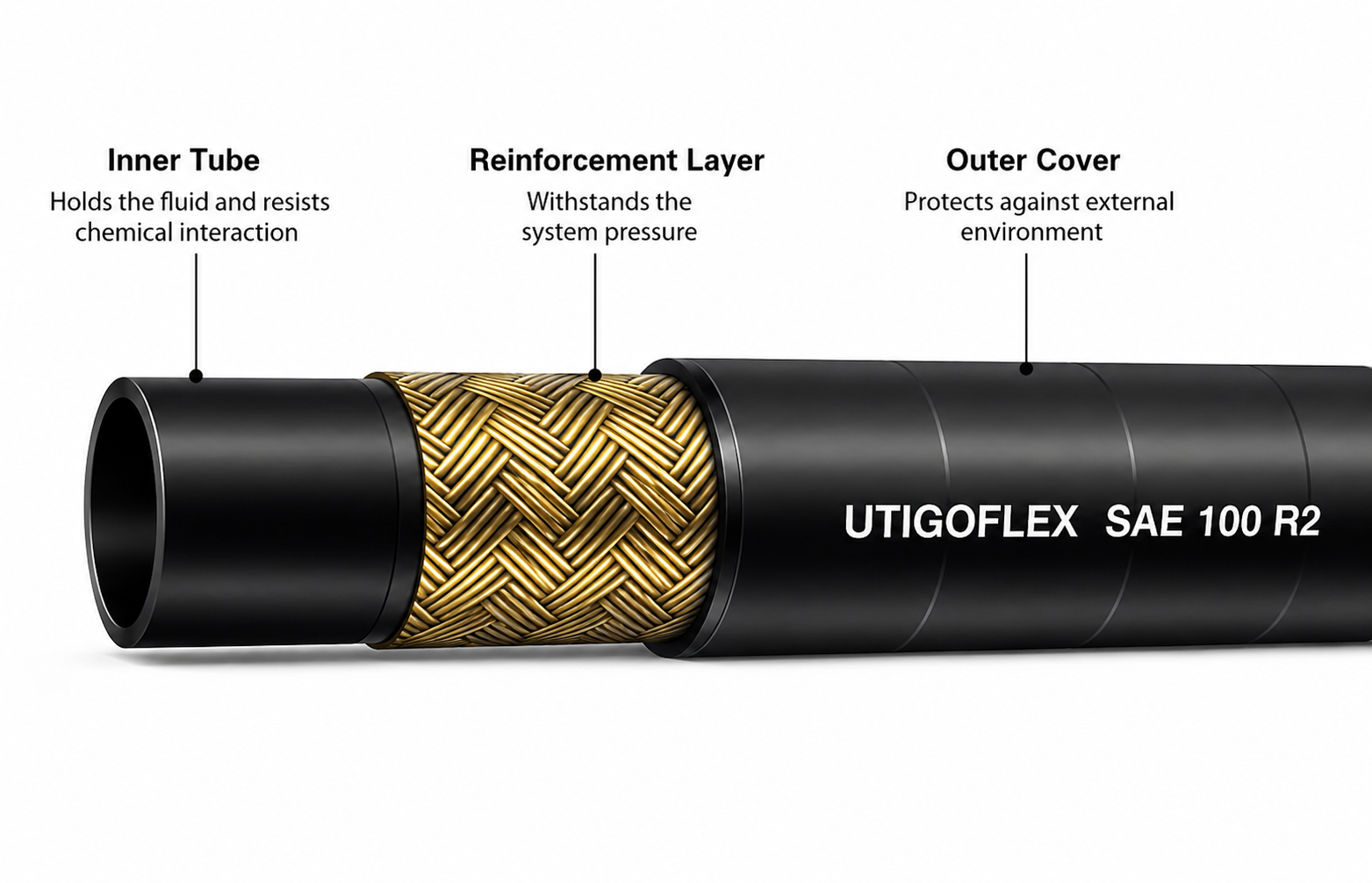
- The Inner Tube: This layer must maintain complete chemical compatibility with the specific hydraulic fluid used, ensuring it resists breakdown or erosion over time.
- The Reinforcement Layer: Usually composed of braided or spiral-wound high-tensile steel wire. This engineering layer takes the structural pressure load.
- The Outer Cover: Acting as a shield, this layer protects the steel reinforcement from weather elements, ozone, abrasion, external oil splashes, and UV damage.
Without a reliable assembly, the most powerful hydraulic pump in the world becomes completely useless because the fluid power can never reach the actuator safely.
3. Why Hose Assemblies Are the “Weakest Link”—And the True Cost of Failure
In a properly engineered hydraulic system, the rigid steel pipes are strong, and the metal pump housing is highly robust. Consequently, the flexible hydraulic hose assemblies are almost always the most vulnerable parts of the machine.
Because they must remain flexible during operation, hoses are constantly subjected to severe physical stress:
- Flexing Fatigue: Bending repeatedly beyond their specified minimum bend radius.
- Mechanical Abrasion: Constantly rubbing against metal machine frames or vibrating brackets.
- Pressure Impulse Spikes: Rapid, severe pressure surges caused by sudden valve closures.
When a single hose assembly fails on the job, the business consequences are sudden and costly:
| Type of Risk | The Real-World Impact |
| Operational Downtime |
Every minute a factory production line or heavy machinery sits idle costs thousands of dollars in lost productivity. |
| Severe Safety Hazards |
A pinhole leak under high pressure can cause dangerous fluid injection injuries through human skin, potentially leading to amputation. |
| Environmental Fines |
Sudden high-pressure oil spills trigger strict regulatory compliance issues and expensive hazardous waste cleanup operations. |
4. Engineering Standards: The “Six Rights” of Hose Selection
When selecting or building a heavy-duty hydraulic hose assembly, procurement teams cannot afford to guess. Technicians and engineers rely on the industry-standard “Six Rights” framework to guarantee a safe, long-lasting setup:
- Right Application: Match the hose to the exact environmental and equipment configuration.
- Right Hose Type: Choose between wire-braided (for flexibility) or wire-spiral (for extreme impulse pressures).
- Right Size: Ensure proper inner diameter (ID) to optimize fluid velocity and cut correct lengths to account for movement.
- Right Fluid Compatibility: Verify that the inner tube can handle specific bio-oils or synthetic fluids without degradation.
- Right Temperature Rating: Ensure the assembly handles fluid heat (standard hoses support up to +100°C/+212°F, but specialized applications like foundries require advanced thermal compounds).
- Right Pressure Rating: Never allow system working pressure to exceed the hose rating. Standard safe engineering dictates a 4:1 safety design factor (where the hose burst pressure is 4 times higher than its rated working pressure).
Additionally, fittings and crimping account for 50% of the assembly’s integrity. A poor or uncalibrated crimp will result in the metal fitting blowing off catastrophically under load. Always follow the manufacturer’s exact crimp specifications.
5. Visual Inspection: Your 60-Second Defense Against Downtime
Preventing sudden system failures does not require expensive diagnostic machinery. A simple, 60-second visual inspection before a shift can catch major issues early.
Walk your equipment lines and check for these five red flags:
- Active Leaks: Fluid weeping or pooling around the crimped metal fittings.
- Cover Blisters: Bubbles on the outer cover, indicating internal fluid has bypassed the inner tube.
- Deep Cuts or Abrasion: External wearing that exposes the structural steel wire reinforcement beneath.
- Twisted Hoses: Hoses installed like a corkscrew, which drastically reduces pressure resistance under load.
- Localized Soft Spots: Sections that feel soft, pointing to broken internal reinforcement wires.
Pro Procurement Tip: Always tag or label every hydraulic hose assembly with its exact installation date. Replace assemblies that have exceeded their recommended service shelf-life—typically 5 to 10 years, depending on the intensity of the operating environment.
Conclusion: Invest in Premium Assemblies to Protect Your Equipment
It can be tempting to cut costs on hydraulic hoses—after all, to the untrained eye, they look like simple rubber tubes. But when you understand the physics occurring inside that assembly—pressures exceeding 6,000 PSI and pressure impulses hitting 30 times per second—your engineering perspective changes.
A premium hydraulic hose assembly is not an operational expense; it is insurance for your entire business asset. It represents the thin line between a highly productive workday and a catastrophic, expensive shutdown.
Build Your Safe Systems with Utigoflex
At Utigoflex, we specialize in manufacturing high-performance hydraulic hose assemblies that strictly adhere to the 4:1 safety factor and precise crimp tolerances. Don’t leave your machinery safety to chance.
[Contact Utigoflex Today] to request a specialized quote or download our complete technical assembly catalog.

