You are here: Home1 / Blog2 / Product Knowledge3 / Why Are Industrial Hose Certifications (ISO, REACH, UL) Important?
Why Are Industrial Hose Certifications (ISO, REACH, UL) Important?
Industrial hoses are critical components in industries ranging from manufacturing and construction to food processing, chemical handling, and oil & gas. They transport liquids, gases, steam, chemicals, and abrasive materials under demanding operating conditions. A hose failure can result in equipment damage, production downtime, environmental contamination, or serious safety incidents.
This is why industrial hose certifications play a vital role. Certifications such as ISO, REACH, and UL demonstrate that a hose has been manufactured, tested, and evaluated according to recognized international standards. They provide assurance that the product meets specific requirements for quality, safety, environmental compliance, and performance.
In this article, Utigoflex will explain why industrial hose certifications matter, what the major certifications mean, and how they help buyers choose reliable hose products.
What Are Industrial Hose Certifications?
Industrial hose certifications are official standards or regulatory approvals that verify a hose meets defined technical, safety, or environmental requirements.
Depending on the application, certifications may evaluate:
- Material quality
- Pressure performance
- Temperature resistance
- Chemical compatibility
- Flame resistance
- Electrical properties
- Environmental compliance
- Manufacturing quality control
For manufacturers, certifications demonstrate product consistency and quality. For customers, they reduce purchasing risks and ensure compliance with industry regulations.
Why Are Hose Certifications Important?
1. Improve Product Safety
Safety is the primary reason for obtaining certified industrial hoses.
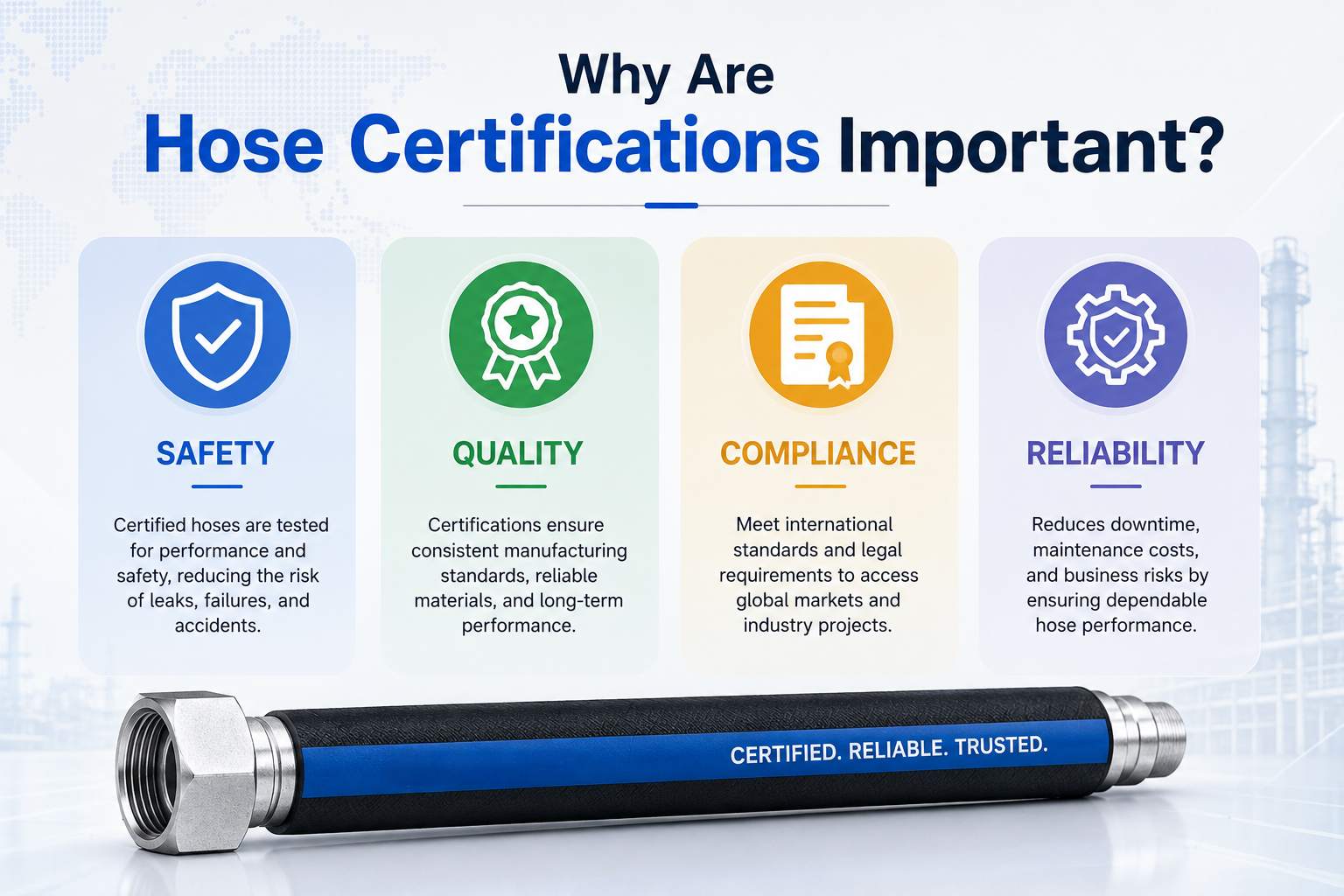
Industrial hoses routinely transport hydraulic oil, compressed air, steam, fuel, chemicals, food-grade liquids, and high-pressure water under demanding operating conditions. If a hose fails during operation, it can lead to fluid leakage, fire hazards, chemical exposure, equipment damage, worker injuries, and costly production shutdowns.
To ensure reliable performance, certified hoses are typically tested for critical characteristics such as:
- Burst pressure
- Working pressure
- Pressure impulse resistance
- Tensile strength
- Flexibility
- Temperature performance
These tests help ensure that hoses perform safely under their intended operating conditions.
2. Ensure Consistent Manufacturing Quality
A hose may perform well in laboratory testing but still fail if manufacturing quality is inconsistent.
Certification systems require manufacturers to establish standardized production processes, including:
- Raw material inspection
- Process control
- Quality testing
- Traceability
- Final product inspection
Consistent manufacturing minimizes product variation and improves long-term reliability.
3. Meet International Market Requirements
Many countries and industries require certified products before they can be sold or used.
For example:
- European customers often request REACH compliance.
- North American projects may require UL-certified products.
- Global OEMs frequently specify ISO-certified manufacturers.
Without appropriate certifications, manufacturers may face barriers when entering international markets.
4. Reduce Business Risk
Using uncertified hoses increases the risk of:
- Product recalls
- Equipment failures
- Warranty claims
- Legal liability
- Regulatory penalties
Certified products provide documented evidence that the hose has been manufactured according to recognized standards, helping reduce both technical and commercial risks.
Understanding Major Industrial Hose Certifications
ISO Certification
ISO (International Organization for Standardization) develops globally recognized standards for quality management and manufacturing processes.
For hose manufacturers, the most common certification is:
ISO 9001 – Quality Management System
ISO 9001 does not certify a specific hose product. Instead, it certifies that the manufacturer follows a structured quality management system throughout production.
An ISO 9001-certified manufacturer typically has procedures for:
- Supplier management
- Production control
- Inspection and testing
- Corrective actions
- Continuous improvement
- Customer satisfaction
ISO certification helps manufacturers achieve stable product quality, better manufacturing consistency, improved traceability, higher customer confidence, and reduced production defects.
Many global buyers prefer sourcing hoses from ISO-certified manufacturers because it indicates reliable quality management.
REACH Compliance
REACH stands for:
Registration, Evaluation, Authorization and Restriction of Chemicals
It is one of the world’s most comprehensive chemical safety regulations and applies to products entering the European market.
REACH aims to protect human health, worker safety, consumer safety, and the environment.
Why REACH Matters for Industrial Hoses
Industrial hoses contain various materials, including rubber compounds, plasticizers, reinforcement materials, adhesives, colorants, and processing chemicals. Some substances may contain hazardous chemicals restricted under REACH regulations.
REACH-compliant hoses help ensure that restricted substances remain below allowable limits or are not used at all.
Benefits of REACH Compliance
- Easier access to European markets
- Improved environmental responsibility
- Better workplace safety
- Greater confidence for international buyers
Many multinational companies now require REACH compliance even outside Europe as part of their sustainability and supply chain policies.
UL Certification
UL (Underwriters Laboratories) is one of the world’s leading safety certification organizations.
UL certification is particularly important for hoses used in applications involving electrical equipment, fuel systems, fire protection, industrial machinery, and HVAC systems.
UL evaluates products based on rigorous safety testing. Depending on the hose type, testing may include:
- Flame resistance
- Electrical insulation
- Heat resistance
- Aging performance
- Material durability
- Pressure testing
Benefits of UL Certification
UL certification demonstrates compliance with recognized safety standards, increases acceptance in North American markets, enhances customer confidence, and supports compliance with local building and industrial codes.
For many industrial projects, UL certification is a mandatory requirement rather than an optional feature.
At Utigoflex, we believe transparency builds trust. You can review our certifications and compliance documents on our dedicated certification page.
Other Common Hose Standards
In addition to ISO, REACH, and UL, industrial hoses may also comply with industry-specific standards depending on their intended application.
Examples include:
| Standard | Purpose | Typical Applications |
| SAE | Hydraulic hose performance | Construction equipment, hydraulic systems |
| EN | European industrial hose standards | Industrial and commercial applications |
| DIN | German engineering standards | Mechanical and hydraulic equipment |
| FDA | Food-contact material compliance | Food and beverage hoses |
| RoHS | Restriction of hazardous substances | Electrical and electronic equipment |
| NSF | Drinking water safety | Potable water systems |
Different industries often require compliance with multiple standards simultaneously.
How Certifications Benefit Buyers
Choosing certified industrial hoses offers several practical advantages.
- Better Product Reliability: Certified hoses undergo standardized testing, resulting in more predictable and consistent performance.
- Easier Supplier Evaluation: Certifications provide an objective benchmark when comparing manufacturers, reducing uncertainty during supplier selection.
- Lower Maintenance Costs: Reliable hoses generally experience fewer failures, reducing downtime, lowering replacement frequency, minimizing maintenance requirements, and improving equipment efficiency.
- Greater Regulatory Compliance: Certified hoses simplify compliance with customer specifications, government regulations, and international trade requirements.
How to Verify a Manufacturer’s Certifications
Before placing an order, buyers should verify certification claims by requesting:
- ISO certification certificates
- REACH compliance declarations
- UL certification numbers (if applicable)
- Product test reports
- Material safety documentation
- Third-party inspection reports
It’s also important to ensure that certifications are current, issued by recognized organizations, and applicable to the specific hose product being purchased.
Common Misconceptions About Hose Certifications
Several misconceptions can lead to confusion during the purchasing process.
Q: “ISO Certification Means Every Product Is Certified”
A: Not necessarily. ISO 9001 certifies the manufacturer’s quality management system, not the performance of individual hose products.
Q: “REACH Is Only for European Customers”
A: While REACH is an EU regulation, many global companies require REACH-compliant materials across their entire supply chain.
Q: “UL Certification Is Required for Every Hose”
A: No. UL certification is primarily relevant for applications where safety regulations or customer specifications call for it, such as electrical, fuel, or fire protection systems.
Conclusion
Industrial hose certifications are far more than marketing labels—they provide assurance that products meet recognized standards for quality, safety, environmental compliance, and manufacturing consistency.
Among the most important certifications:
- ISOdemonstrates that the manufacturer follows a robust quality management system.
- REACHensures compliance with strict chemical safety and environmental regulations, particularly for the European market.
- ULverifies product safety for applications where fire resistance, electrical performance, or other safety requirements are critical.
When selecting industrial hoses, buyers should consider certifications alongside factors such as pressure rating, temperature range, chemical compatibility, reinforcement construction, and intended application. Partnering with a certified manufacturer like Utigoflex not only helps ensure reliable product performance but also supports regulatory compliance, reduces operational risks, and builds long-term confidence in your supply chain.
[Contact Utigoflex Today] to request a specialized quote or download our complete technical assembly catalog.

